Yearly Archives: 2013

Summer Update!

My limited spare time has been taken up by practicing piano, as I had a piano lesson in July! My first in over 25 years. I was so nervous my hands were shaking and I made way more mistakes than I usually do. But it was extremely beneficial so I’m glad I did it. Many hours on Beethoven’s Sonata 17, the one Glenn Gould plays like his hair’s on fire and he can’t douse it until he’s through. Obviously I don’t play it that fast, but I’m working on memorization now and I think that will help with a lot of issues. I’ve now been working on this for 6 months! On and off, obviously, but still. My husband’s starting to feel he could probably play it himself by now, he’s heard it so much.

So that’s one reason I’m a bit behind on the blogging. We spent three weeks on Vancouver Island, which we call The Island, and it was gorgeous:IMG_8133

And we made cinnamon buns:

IMG_8170

But we had SO MANY guests. Too many. And when you have guests, you wind up making major breakfast, major lunch, and then a major dinner. For 15! So I had very little down time and that’s exhausting. It’s hard though; I love everyone who came, I’m happy to have seen them, but it was too much. Not sure how we’ll organize things next year but something has to give. I don’t think it’s cool to suffer through stuff that you can totally control and then complain about it later, but that’s essentially what I’ve just done. Sorry! Learn from my mistakes.

Next year’s resolutions:

  • Limit stays to 3 nights MAX.
  • Try to have only one family at a time.
  • Have Leftover Night and if people don’t like it then maybe they won’t come next year. Yes, we’re restaurateurs and we eat leftovers.
  • Let people fend for themselves for breakfast! Everyone gets up at a different time. Brunch once a week only.
  • Ask people to take responsibility for one meal. It’s nice that people bring food, but sometimes it’s extremely difficult to make a coherent meal plan with a lot of rapidly spoiling, diverse ingredients.

Pet peeves:

People who wander through and say vaguely, “Anything I can do?” before wandering out again. It’s annoying to have to be the general all the time. I have to think of tasks for people to do. That’s work in itself.

When people do something helpful but make more work for me in the end. Someone did dishes but didn’t rinse anything first, just got the sponge all clagged up with black grease so I had to throw it away. And you can’t complain! That’s the thing. Because people are Helping. But sometimes no help is better than some help. Like when people put my expensive Japanese knives in the dishwasher! OH YES THEY DID. And I can’t be mad when people are trying to be helpful. But I’m mad anyway, I just feel really guilty about it. You should see me smile with gritted teeth. But. At the end of the day, it’s all good, and I’m grateful to have wonderful friends and family who want to spend time with us! You take the good, you take the bad. I took the good, and now I’m kvetching here.

Now I’ve just come back from being a house guest at someone else’s beach cottage. Ahhh. That was fun! We stayed 3 nights – because that’s enough – and I taught my hosts how to make cinnamon buns.

Next post: book reviews!

6 Comments

Filed under daily deedle-deedle, Uncategorized

Seating Arrangements by Maggie Shipstead

Wonderful books are coming at me from every direction, it seems. Once again I have the amazing librarians at the VPL to thank for putting Seating Arrangements where I would be sure to spy it and add it to my heap of books. I’m actually going to download this as well, the writing is that good. And I have it on hand so I can provide a few quotes to prove just how fun this book is.

When I wrote about Mrs. Queen Takes the Train, I noted a trend in literature coming from the UK. There is a similar yet distinct vein in American writing as well, of which I am equally fond. The best examples are, in my opinion, Richard Russo, Jonathan Franzen, John Irving and Curtis Sittenfeld.  Again, it’s the relatively common-sense expository style that I like. These writers however, are more explicit in their examinations of social mores than are the English.  (Both include details of food and clothing which I love.)

Seating Arrangements deals largely with social striving, the futility of endlessly climbing a ladder which has no end:

“These people, this pervasive clique, this Establishment to which Winn had attached himself and his family, seemed intent on dividing their community into smaller and smaller fractions, halves of halves, always approaching but never reaching some axis of perfect exclusivity.” p. 75

“Years had to pass before Dominique could see the strain they placed on themselves or, rather, what their grand goal was. They wanted to be aristocrats in a country that was not supposed to have an aristocracy, that was, in fact, founded partly as a protest against hereditary power. That was what Dominique could not understand: why devote so much energy to imitating a system that was supposed to be defunct? Any hereditary aristocracy was stupid, and Americans didn’t even have rules for theirs, not really. Lots of the kids Dominique knew at Deerfield came from families dedicated to perpetuating some moldy, half-understood code of conduct passed along by generations of impostors. But, she supposed, people who believe themselves to be well bred wouldn’t want to give up their invented castes because then they might be left with nothing, no one to appreciate their special clubs, their family trees, their tricky manners, their threadbare wealth.” p. 78

Dominique is a Coptic Christian Egyptian who attended private school and later Princeton with the protagonist’s daughters. She provides the outside voice who makes cool observations of the others. The protagonist, Winn, seems at first like a classic East Coast patrician. But as the novel progresses the fragile construct that Winn lives by is slowly eroded as the reader – and Winn himself – discovers just how tenuous his grip on his social status really is. You have to feel pity for Winn as he seems obsessed with a golf club which refuses to admit him. He keeps casting about for reasons and he descends into pitiable gestures, flailings at those he imagines are responsible. His shallow yearnings inspire contempt and pity, and his weak attraction to his daughter’s friend makes it even worse. Meanwhile one of his daughters is hugely pregnant and about to be married, and the other is suffering from rejection and an abortion. The first daughter has completely bought into the faux-aristocratic lifestyle; his second makes bitter observations about the uselessness of all the striving:

“The club, she thought, was an institution that existed for little purpose other than to select its members. Once you were in, then what?” p. 70

“People shuffled the order of love, marriage, and baby carriage all the time, but not people who had grown up under the contiguous roofs of Winn Van Meter, Deerfield, and Princeton.” p. 260

Livia also makes some amusing observations: while being prepped for her abortion, she notices, “an apparatus the size and shape of a small water cooler covered with a quilted, strawberry-printed sort of tea cozy. Was there some booth at a craft fair that sold cheerful, handmade accessories for abortionists?” p. 263

Winn’s concern for his status far outweighs his concern for his daughters and his wife and he seems completely oblivious to the undercurrents and tensions that surround him as guests and family gather for his daughter’s wedding, whilst he simultaneously becomes more and more hysterical about the perceived snub of the golf club. He gives a disastrous toast in which he compares marriage to death: “What else is there to do? You can’t date forever. We don’t want to be alone. We marry, and we live out our lives. Then…well, marriage, even a happy marriage like my own and like I’m sure yours will be, Daphne, is a precursor to death. If you never leave your partner and you’re faithful, marriage has the same kind of finality. there is nothing else.” Awesome. Immediately afterward his new son-in-law explains to the gathering that Winn was knocked off his bicycle earlier and is under the influence of painkillers. And Winn, in the grip of despair at being barred from the holiest of holies, is just getting started. I’m going to stop here before I give it all away.

I find it interesting, the desire – and I don’t think it’s exclusive to Americans – for a kind of caste system in which one is at the peak or at least in sight of the peak. I think it’s significant that the two biggest commercial vendors of this fictional aristocratic image are both immigrants or children of immigrants – Ralph Lauren, formerly Lifshitz, and Martha Stewart, formerly Kostyra. There have been enough wealthy Americans aping British aristocracy for them to be able to re-create, visually, a lifestyle that never really existed. (Jonathan Raban writes about the Ralph Lifshitz/Lauren phenomenon in his book Hunting Mr. Heartbreak.)

Dominique: “As a member of an unpopular minority in her home country, secular though she and her parents were, she thought she should be outraged by WASPy illusions of grandeur and birthright, their smugness, the nepotistic power they wielded. But the worst she could summon was a bleak, mild pity, and more often, she felt a bleak, mild amusement. Her sense was that the Van Meters had to throw more elbows than some to keep their status, and at times she caught herself feeling sorry for them.” p. 79

I suppose there are lots of people who need to feel better than other people, albeit for equally silly qualities or achievements. When I lived in England I kept meeting people who behaved in a very superior manner towards others, but when you talked to them to try to find out exactly how excellent they were and why, it would essentially boil down to the fact that they were born to a family that had pretensions to some kind of social loftiness. They would often have no great skills, or interesting work, or even a university degree. I would have settled for “idle philosopher” but most of them didn’t seem to think, even. They didn’t read, they didn’t engage in the world, yet they considered themselves a cut above everyone else. It all came down to being born. Talk about confusing luck with virtue. I always thought that was very sad – there must be immense depths of insecurity for someone to clutch onto this ephemeral idea of superiority. If you know anything at all about English history, or even if you’ve read Edward Rutherfurd’s London or similar books, you know that titles and aristocracy could be happened upon accidentally, or even bought. Charles II was an impoverished king who sold titles left and right to anybody who had the ready cash. Even in Downtown Abbey, Lord Grantham has married an American woman whose fortune has enabled him to remain Lord Grantham. The rest of the family condescends to Cora, but without her money – her American money – they wouldn’t have a silver pot to P in. In Australia, we discovered that if you want to make an Australian bristle, bring up convict ships. I guess the First Fleet, though it has a cachet of its own, is not exactly the same as the Mayflower. Even the Mayflower – in Bill Bryson’s book The Lost Continent he describes the passengers of the Mayflower as being woefully unequipped and too incompetent to survive life in the New World. There must be something to be proud of in there but I’m not sure what it is.

In my own family, people periodically mention the fact that my great-grandfather entertained the Prince of Wales when HRH came to Canada in the 1920s. I always think, So what? HRH’s train happened to stop in Lethbridge, Alberta, a community that consisted of maybe 20 Doukhobors and then Pete and Margaret Smith, who had come north to Canada leaving behind their Mormon roots in Utah so that they could have a drink in peace. The train had to stop somewhere and Lethbridge was convenient. I picture the royal equerry choosing activities for HRH and pondering: a tour of a Doukhobor farm, or a night with the area’s bon vivant? Tough choice! I don’t drink but even I would choose to hang out with Granddad Pete over touring a pig farm. Of course, I have actually toured a Doukhobor farm on a family visit so I know of which I speak – being a city kid, I found that the farm produced aromas that I found, um, strong, so I was holding my hand to my face. One of our Doukhobor hostesses, a lady in a starched apron and wire-rimmed glasses, frowned at me and flicked my hand away from my face, like I was going to offend the pigs. I retaliated by lifting my t-shirt over my nose and glaring at her over the collar.

So, “entertaining royalty”, though it sounds good, just means that Granddad could party and there was nobody else available who spoke English and not Russian. Dubious distinction at best! Why do we have such a weakness for our little pedigrees? What does it all actually mean? In the New World, not a whole lot, and that should really apply to the Old World as well. Remember the French Revolution? How long did it take for Napoleon to resurrect all that noble fawning? In Communist countries, party officials become puffed-up elites clad in Louis Vuitton bought with kickback money. Drug dealers use their ill-gotten loot to gain admittance for their children to private schools in attempts to achieve respectability, like the Corleones. Climbing, climbing, always climbing, trying to forget from whence we really came.

Anyway, enough about me. Seating Arrangements pokes fun at this phenomenon more eloquently than I can, it’s hilarious, and the writing is wonderful. And Ms. Shipstead was born in 1983! She’s so young but has such a grip on the language. Kudos to her. There were no mistakes in grammar or usage which was a a relief, although this is often the failing of editors and copyeditors. (In this week’s edition of Maclean’s magazine (Canadian news magazine) someone wrote, “a lower-wrung staffer” – italics mine. I winced when I read it.)

Comments Off on Seating Arrangements by Maggie Shipstead

Filed under Books

Seven Annoying Things People Say to Pianists

Emily says it so well…..I have a sad memory about being asked to play something at the last minute: when my great-grandmother died, my father asked me – 1 hour before we were to leave for the memorial service – if I would play her favorite song, “Beautiful Dreamer.” I had some music for it, but I just couldn’t prepare it quickly enough so I refused, and my dad was really mad at me that whole day. I’ve always wondered if I should have just blundered through it, but it felt really wrong.

5 Comments

Filed under Music

Fleetwood Mac

My parents were children of the ’50s and ’60s – mostly the ’60s, and their musical tastes reflected this fact. My dad had the Stones’ White Album, and I grew up listening to Elton John and Iron Butterfly. In the ’70s, my mom bought Andrew Lloyd Webber and Tim Rice’s Jesus Christ Superstar, and Dad bought Fleetwood Mac’s Rumours album. I still know all the words to Goodbye Yellow Brick Road and Don’t Shoot Me, I’m Just the Piano Player – the albums, not just the songs, and I can identify a Fleetwood Mac song within the first bar. My dad’s taste was particularly eclectic. I never could figure out the parameters of his taste, and he had odd limits. For instance, he had all the Elton John albums as long as Bernie Taupin was John’s lyricist. After Taupin left, no more Elton John. I guess Bernie Taupin was The Man. He had all the classic rock, but as we moved into the ’80s, his taste started to range far and wide. I remember eating Sunday brunch on the patio to the strains of Jimmy Buffett’s Margaritaville album. He had Steve Winwood’s album, the one that was hard to get hold of, before anybody else. He also had Dolly Parton and Billy Ocean. “Caribbean Queen” is one of those songs that will stick in your head and drive you to insanity. Dad used to wake me up in the mornings on the weekends by blasting Wagner’s Ride of the Valkyries. (My mother favoured Van Cliburn and Itzhak Perlman.) Saturday mornings were about housework, in our house, and although Dad did the brunt of it, he hated to work whilst others lazed around. And we had to get up early on the weekends, too, as though we were farmers and had cows that needed milking.

So my musical taste, too, is whimsical and hard to pinpoint. I love classical music, but nothing too obscure, and nothing too popular. I like a tune I can whistle, but not one everyone can whistle. When my sister got married I recommended the Adagio from Mozart’s Clarinet Concerto – forestalling the inevitable selection of Pachelbel’s Canon. I’m glad she went with my recommendation. Sweet, wistful, with Mozart’s inevitability, and familiar enough to most of the congregation, the Adagio went perfectly with my sister’s entrance and walk down the aisle. My favorite classical playlist includes the Adagio, Bach’s Air on the G String, and Beethoven’s “Emperor” Concerto. I have a lot of piano music as well, Mozart piano sonatas, Debussy’s Suite Bergamasque, Chopin Nocturnes and Impromptus. Also some opera arias – I’m not an opera buff but I like some of the more famous arias. I find that iTunes is great for finding obscure classical music, but “shuffle” is not meant for your classical playlist.

When you look at my pop playlists, there are definitely some odd selections, I’ll admit. I have a weak spot for one-hit wonders, like Jermaine Stewart’s We Don’t Have to Take Our Clothes Off (To Have a Good time) or Ace of Base. I have a little bit of country in there too: Dixie Chicks, Lady Antebellum, Taylor Swift and John Denver. Amy Grant and Peter Cetera’s duet “Next Time I Fall”. The B-52’s “Roam.” I have a ’50s playlist, and an ’80s playlist that runs to hundreds of songs. Yes, it’s far out. It takes me a while to catch on to new music nowadays, as I don’t listen to the radio the way I used to when I was young. So, lots of old stuff, and LOTS of Fleetwood Mac.

So, we went to see Fleetwood Mac last week! They played Rogers Arena and it was sold out. This surprised me as I asked some friends if they liked Fleetwood Mac and they responded diplomatically, “Um….not really.” It was like I’d asked if they liked liver. It was not easy finding people to come with us to this concert – and we had access to box seats! We ended up going with one other couple, and our kids.

I don’t go to rock concerts in general. They’re always too loud and it’s not comfortable. People get excited and jump on your toes. I think I can count the concerts I’ve been to on one hand. Let’s see: Lionel Richie, Rolling Stones, George Michael, Lady Gaga, Fleetwood Mac. Yep! I may have missed a few but I don’t think so. The last 3 were in box seats else I wouldn’t have gone to those either. I don’t like crowds.

But Fleetwood Mac is special to me. It reminds me of my father. It reminds me of being young. I used to do border runs for my boss when I worked at a classical CD store, and I would play Fleetwood Mac’s Greatest Hits because it was a CD that I could play straight through without wanting to skip songs. So there I was, 21 years old, driving down the highway on a sunny Friday afternoon….listening to Fleetwood Mac. I was geriatric even then! But how can you not love Christine McVie’s cool alto, Lindsay Buckingham’s guitar licks, Mick Fleetwood’s demented drumming, Stevie Nicks’ raw honeyed voice…..John McVie’s….bass playing? Unfortunately, Christine McVie did not join this tour, which was a major drawback as she sings my favourite FM songs. You can tell what she’s saying, unlike when Stevie sings. I love her but her enunciation is worse than Alanis Morrissette’s. It makes them difficult to sing along with, no?

I don’t know what the median age of the concert-goers was, although I suspect my parents would have fit right in. My children being there must have lowered it a bit. We gave them earplugs and one sat on my lap, and we hugged and listened to Stevie Nicks sing “Sara.” And I was overcome with emotion, remembering my father, and thinking about how much he would have loved to have been there, and how much he would have loved to be my girls’ grandfather. I miss him so much sometimes, and at this Fleetwood Mac concert I was hit by such a wave of grief that I was thankful for the darkness and the din. I pressed my face into my daughter’s head and her soft hair soaked up my tears. You never get over losing someone, though you carry on, and live, and function. It’s been 14 years and sometimes the pain is as sharp as it was the day he died. Most of the time, I keep myself buttoned up, because the show must go on, stiff upper lip, no use dwelling, etc. Also because I’m frightened by the abyss that grief opens up inside you. I’m afraid that if I give in to it, I’ll never return. And this is after I’ve had therapy! Anyway, this one time I let myself feel the pain and loss. I felt a sense of safety in the darkness, with the music playing and my daughter in my arms.

So, it was a good concert, even without Christine McVie. Stevie Nicks has cornered the market on black velvet dresses, methinks, and her voice is still the same and I won’t hear anything rude about it. Mick Fleetwood played with such vigor that we just hoped he remembered to take his medication, because, damn. My kids mistook him for Santa. Lindsay Buckingham’s voice and guitar playing – eternal. The energy and talent of these people is truly astounding, and they don’t give off waves of dissipation the way the Stones do. The children sat patiently through it all and didn’t complain once. I cheered up and our friends sang along with me to the easy-to-sing-along-with songs like “Don’t Stop” which brought the entire stadium to its feet. (It’s hard to sing along to “Tusk.”) If Elton John comes to Vancouver I’ll remember to bring a box of tissues. (Although not if he’s going to play a bunch of post-Taupin stuff.)

6 Comments

Filed under Music

My eclectic reading list

I can’t post any more Internet pictures of books because I heard about somebody being sued for that. And the following were library books and they’ve already gone back to the library so I can’t take a picture myself. Sorry!

How To Be a Woman by Caitlin Moran: I was expecting a lighter take on feminism when I picked this book up (actually had it on hold for ages, it’s popular) but I was surprised and pleased to discover that Moran is quite serious about her topic. She has a self-deprecating, aggressively funny way of making her point so the book is fun to read, but she made me think hard about my own definition of feminism. Her definition? “If you have a vagina and you want to be in charge of it, you’re a feminist.’ In a nutshell! What I remember most about this book was the difference between “being” and “doing” – she points at the WAGs (wives and girlfriends of professional athletes) and people like Katie Price (this woman is famous for having a topless photo of herself in a British tabloid – it’s a British thing – but that is it, and she’s parlayed this into a major empire of self-promotion) who are “being” various things: famous, photographed, having reality shows made about them. I think a good North American parallel is Kim Kardashian. I’ve been irritated before with people who are famous for…nothing! They’re good looking, but seriously? Why pay any attention to them? Then Moran points to Lady Gaga to illustrate the difference. Unlike Katie Price, who has nothing to say for herself, Lady Gaga has lots to say, and she’s come up with original and intriguing ways to say it. Lady Gaga is “doing”, not “being.” It’s an important distinction, boiled down into two words, and I’m remembering it as the kids grow up.

Mrs. Queen Takes the Train, William Kuhn – I don’t know who recommended this book, but whoever it was, Thank you! There is an identifiable style of writing coming from the UK nowadays that I particularly enjoy. I think it’s becoming its own genre. The language tends to be plain and relatively simple. The words chosen are precisely the right words and convey the exact nuance that the writer intends. The subjects are usually fairly matter-of-fact and down-to-earth. For all that that sounds so boring, the results are incredibly charming and addictive. There is amazing depth of emotion, and all kinds of nuance, and it’s clearly conveyed yet not obvious. There are no signposts, but you find your way anyway. How do they do it? Mark Haddon writes in this style, as does Kate Atkinson, and now William Kuhn. I would tentatively put Alan Bradley in this category as well. The details provided are the details that enhance the story and add interest, not long paragraphs of description that go nowhere. No flights of fancy here! The dialogue is very real and sounds like people talking. I know, when I describe it it doesn’t sound thrilling but it is, it is. If I can’t properly express how wonderful these writers are this is my fault. Anyway, Mrs. Queen Takes the Train is a prime example of this minimalist – but not – style that I love so much. It’s hard to believe that it’s fiction, even with the bits about the Queen taking up yoga, as it’s so realistic. Basically, the Queen borrows a hoodie from an employee, gets routed out of the palace grounds by workmen by mistake, then decides to take a train to Edinburgh to see the decommissioned Britannia. She manages to get there incognito – with concerned staff hot on her trail – and is taken for a cleaning lady by the guards at the port. She actually does the washing-up in the galley – my favorite part. Charming and fun. I’m a bit of an Anglophile so I was particularly enchanted but I think anyone would enjoy this book.

At my local branch of the Vancouver Public Library, there are shelves in which library staff arrange books according to a weekly or monthly theme, or just “staff picks.” Whoever they are, they have the best taste. I have found so many new writers just by trusting in their judgment. In a Foreign Country by Charles Cumming is my latest leap of faith and I was amply rewarded. I adore spy and crime novels, especially period ones, and this book sent me rushing back to the library website to find his other books. They all came in today and I’m gloating over the pile like Midas. Having a big stack on my bedside table makes me feel rich, rich, rich. And under pressure.

John Elder Robison is the older brother of Augusten Burroughs, who is famous for writing Running with Scissors, which was made into a movie. Robison has Asperger’s Syndrome, and has written two books already about his experiences, Look Me in the Eye and Be Different. Raising Cubby is his latest, and I only found it because the wonderful library people had set it aside in the “New” section. Raising Cubby is about his son, who also has Asperger’s – no surprise, as Robison’s wife also has Asperger’s. Cubby’s interest in chemistry led to his experimenting with explosives which led to his being charged with making bombs. The problem with a lot of gifted kids, especially those who are on the Asperger’s scale, is that they are so absorbed in their interests that they can’t imagine how they might be perceived and misunderstood by others and Cubby is a prime example. Combined with a DA who thinks convicting a teenager will boost her career, the situation becomes a nightmare. I am loving books like this, and also fiction that tackles brain disorders like Lisa Genova’s books, Still Alice, Left Neglected and Love Anthony (which I haven’t read yet but am saving). Robison is a spokesperson for Asperger’s and an amazing writer.

Selling the Dream: Ken Campbell is a sports writer with deep roots in the hockey community. Selling the Dream is about how hockey has become a rich man’s sport, with every parent whose kid can stay upright on skates having NHL dreams and sparing nothing to achieve them. I don’t want to say too much here, because this is a controversial topic and people can be crazy when it comes to kids and hockey. I don’t need nutters Googling Campbell’s book and coming up with this and then freaking out at me, which has actually happened already on another topic. I don’t even have a son, which, frankly, I’m almost grateful for as I suspect my husband would be just as hockey-mad as some others around here. It’s like I’ve dodged a bullet. Basically, Campbell is saying that you can’t manufacture a star player. But people are trying, by throwing money at coaches, trainers, elite hockey schools, spring hockey, summer hockey, you name it. Interestingly, he’s critical of Malcolm Gladwell’s Outliers – Gladwell’s theory of the magic number of 10,000 hours to achieve proficiency has, in his opinion, given rise to much of this mania. This theory has misled many into thinking that if they can just get their kid enough ice time, enough training, enough games, that they will morph into an NHL player. It’s sad. There are so many stories of families who make incredible sacrifices in order to fuel this dream, and generally – like, 99.99% of the time – their dreams are not realized. People start putting money into their kid’s hockey, then put in more because of the psychology of previous investment, and then because they’re so invested the kids feel incredible pressure to perform. Even if they don’t want to play any more, they feel they don’t have a choice. What kind of childhood is that? Then, paradoxically, the parents are willing to risk this investment – and their child’s health – by often insisting that the child play with concussions and injuries. There is a whole chapter on this and it is heartbreaking. OK, I said I wouldn’t say a lot here and I’ve said more than I meant to already. Anyway, Campbell says sure, chase the dream, but have some perspective, that’s all. What kills me is that the people who really should read this book, won’t.

Eclectic enough for you? You won’t hear from me for a while as I’m just starting In The Shadow of the Sword: The Birth of Islam and the Rise of the Global Arab Empire by Tom Holland. 428 pages. I’ll be finished by the end of the week, insha’allah, provided I’m not distracted by the pile of spy novels calling my name.

3 Comments

Filed under Books

Dreams and Shadows by C. Richard Cargill

I’m exploring more fantasy fiction lately. (I’ve just downloaded a Terry Goodkind novel. If it’s good then apparently I’ve got loads to get through. I’ll let you know.) I did a post on Game of Thrones and fantasy literature and it got me thinking that I should do more exploration of this genre. But I’ve taken a sideline into the kind of fiction that has a lot to do with magic and the collision of worlds as opposed to outright fantasy. Lev Grossman’s The Magician and Erin Morgenstern’s The Night Circus are good examples of this trend.

Ten pages into Dreams and Shadows I was looking in the front flap to see what else Cargill has written because I was absolutely captivated and was hoping to find a long list of books. Alas, Dreams and Shadows is his first. I hope he turns out to be one of those prolific writers who produces a book a year at least. I’m sure his publishers are thinking the same. What kind of contract are we talking about? I’m hoping a 10-book contract! AT LEAST. Because Dreams and Shadows is wonderful and I just ripped through it.

Comments Off on Dreams and Shadows by C. Richard Cargill

Filed under Books, Uncategorized

Fairy Tales from the Brothers Grimm: A New English Version by Philip Pullman

When I was young, someone gave us a book of fairy tales. These were not the Disney versions. They were the dark, original versions full of gore, people being killed and rising from the dead, Cinderella’s stepsisters having their eyes pecked out. Of course that instantly became my favourite book of fairy tales. No bowdlerization there! When you’re a kid, you’re always suspecting that something’s being kept from you – because it is – so when I encountered a book that held nothing back, I was delighted. It felt honest, and real. Plus, the villains were usually punished in appropriately graphic fashion. In a world full of unfairness, it was satisfying to read stories in which everything came out right and the bad guys got their just desserts.

150Philip Pullman (author of The Golden Compass) has re-told these stories, keeping in the gore but editing for clarity and concision. It’s a fabulous read. I read one story aloud to my daughters and they loved it too, so I might have to buy this (I confess I got this from the library) so they can read for themselves. I tried to find an original Grimm’s fairy tales book for them (my mother having given away all the books of my youth!) but in these PC times, all you can find are extremely edited and saccharine versions. It’s sad. Kids know when something’s being sugar-coated and the modern versions are just so slack and pale.

king1

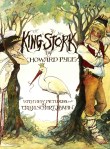
The fairy tale books we favour are those that at least have wonderfully dramatic illustrations. My favourite illustrator is Trina Schart Hyman, whose work illuminates and brings to life the wonderful fairy tale, King Stork by Howard Pyle.

Back to Pullman: my favourite story in the original Grimm book is in Pullman’s book too! It’s The Goose Girl.  A princess rides on her talking horse to marry a prince in a far land. On the way, her maidservant pulls off a coup of sorts, forcing the princess to change places with her and swear not to speak of it. The maidservant marries the prince and orders the horse killed for fear the horse will speak of her perfidy. The princess is made to herd geese and the horse’s head is mounted on the wall. The princess and the head converse from time to time and eventually things come to the attention of the prince, who tries to get the goose girl to speak of her troubles, but she has sworn not to and refuses. He tells her she can tell her troubles to the stove (!) as that would not be breaking her vow, and hides so he can eavesdrop on her. All is revealed. The goose girl is restored. The maidservant, who has apparently forgotten her own history, is asked what the punishment should be for a maid who has usurped her mistress’ place. Her verdict: the culprit should be put naked into a barrel studded with nails and dragged behind two white horses until dead. So that’s what they do. Awesome.

It’s not perfect, obviously. What kind of princess lets her maid take over like that? Why didn’t the horse stop the maidservant from overriding the princess? Weird. But then these old fairy tales are often full of inconsistencies and odd turns. They’re fairy tales, after all. Logic is not an essential. Good and evil, wrongdoing and punishment, magical flora and fauna, virtuous acts rewarded with a shower of gold and immediate elevation to royalty; that’s what fairy tales are all about. And Pullman’s versions are exactly that. In his own words: “I didn’t want to put them in modern settings, or produce personal interpretations or compose poetic variations on the originals; I just wanted to produce a version that was as clear as water.”

king3

2 Comments

Filed under Books

Some lighter reading: Paris in Love and Vinyl Café

After Sex at Dawn I took a break and enjoyed some lighter reading. Now I’m onto a book about World War II by Antony Beekov. I don’t know if I’m going to be able to post about that, it’s like 900 pages of small print on onionskin paper, but I’ll post about the light stuff:

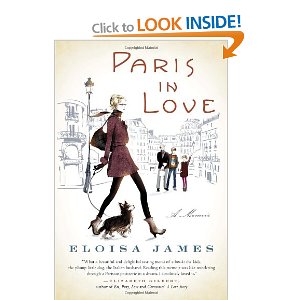
51ihty1lg9L._BO2,204,203,200_PIsitb-sticker-arrow-click,TopRight,35,-76_AA300_SH20_OU15_Paris in Love is a memoir by Eloisa James. She and her family took a sabbatical year and spent it in Paris and it sounds just great. Books about Paris always make me want to shop and eat. Interestingly, Eloisa James is also a romance writer with very good reviews so I thought I’d download one of her books. I downloaded The Ugly Duchess because the title is funny and it’s very well written. I don’t read romances any more but I went through a period of connoisseurship when I was a teenager so I can tell a good historical romance when I see one. James’ book doesn’t seem as dense as say, one of Kathleen Woodiwiss’ novels, but it’s very witty and fun and is moving along briskly. (I feel a post on romance novels coming on….)

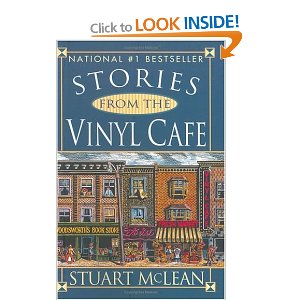
51APWP4S0AL._BO2,204,203,200_PIsitb-sticker-arrow-click,TopRight,35,-76_AA300_SH20_OU15_Vinyl Café is a creation of Stuart Maclean, a Canadian writer and radio personality. He dreamed up a typical Canadian family living in Toronto, and has a series of books which charmingly and hilariously relate episodes in their lives. These people get into more scrapes than Anne of Green Gables (another Canadian literary creation.) I wonder if that’s a Canadian thing. We just get into trouble, darn it. Anyway, these stories are laugh out loud funny so you can’t read them before bed, and not on a plane either. But I cannot recommend them highly enough. Maclean also has podcasts on CBC for download through iTunes, and I’ve been listening to them while I do chores around the house this weekend. If you download one, look for the names “Dave” and “Morley”. “Dave and the Bike” is a good one. The podcasts are of live shows Maclean has done around the country, so the first part is usually a lyrical talk about the history of the town he’s in, then there’s a musical interlude or two, then he gets into the story. So if you want to just hear about Dave and Morley then skip ahead until the last bit of music and applause stops. He’s a great speaker and storyteller. His podcasts kept me in a good mood all weekend despite payroll and laundry and changing bedding. “Stories from the Vinyl Café” is the first one, but the second one, “Home from the Vinyl Café” is even better.

Comments Off on Some lighter reading: Paris in Love and Vinyl Café

Filed under Books

My List: The Powerful Actors

Disclaimer: I’m having a light day. I’m going back to book reviews soon but am being self-indulgent and thinking about movies lately:

After my review of Les Misérables, I got to thinking about actors and how some actors not only have great range and ability to convey emotion, but can project power. Just standing, they have enormous presence – your eye is drawn to them and they effortlessly hold your attention. I wonder why that is but I can’t figure it out. What I can do is post a lightweight piece (I’m having a lightweight day) about my favourite “power” actors (I’m just dealing with men right now; I’ll deal with women some other time):

Russell Crowe: Obviously he comes first to mind as I just saw him play Javert in Les Mis. But when I think “power” I think of Maximus in the Colosseum, head slightly lowered like a bull about to charge, and murderous intent in his eyes. Power comes out of him in nearly visible rays. The soundtrack of Gladiator helps but Russell Crowe has tremendous presence and also a good range, which is a quality I’m factoring in here. Being able to look menacing isn’t enough to make the list. He has a somber face but when he smiles something happens in his eyes and you could knock me over with a feather. Cinderella Man? Master and Commander? This is why he is number one.

Serious Crowe

MV5BMTk1NjA3NDQ0N15BMl5BanBnXkFtZTcwNzM0OTE4OA@@._V1._CR342,0,1363,1363_SS100_

Happy Crowe

Denzel Washington: If I hadn’t just seen Russell Crowe play Javert I probably would have placed Mr. Washington first. He can be loud and raucous, he can be quiet and introspective, he can project suffering with liquid eyes (remember the whipping scene in Glory?),  he can do it all. He has a smolderingly dangerous presence, and even though he’s incredibly good-looking he has an everyman quality that is essential to place on this list.

Liam Neeson: Authority. Strength. Vulnerability. Even in Love, Actually he was a towering presence like an eagle amongst sparrows. When there’s an emergency, everyone will look to him. Like they did in The Grey.

Daniel Day-Lewis: Obviously. “Stay alive! I will find you!” And she did, and he did. I haven’t seen Lincoln yet but apparently he kicks ass in that too. And, of course, A Room With a View. Talk about range! Check! Everyman quality, check. Power, check.

Philip Seymour Hoffman: This is probably the third time I’ve mentioned that PSH should have played Henry VIII in The Tudors and it’s because he has the presence to play such a larger-than-life monarch. Henry VIII was a monster and megalomaniac but apparently he could also be quite charming and I think PSH would have conveyed those qualities very well. Jonathan Rhys Meyers, though gorgeous, doesn’t quite project the power that you need for this particular monarch. Nobody can do weary irony quite like PSH either, and every time I see him do it I get a thrill. Actually maybe it’s just how he’s feeling at the time. I just watched Mission Impossible III and I wonder if the ironic look on PSH’s face just is him thinking, “What am I doing here?” It’s hard to say. But he was wonderful in Patch Adams and The Talented Mr. Ripley and Doubt and I haven’t seen The Master yet but I hear he’s amazing in that too. That voice!

Eric Bana: He actually did play Henry VIII in The Other Boleyn Girl, with some success. Again, Henry VIII was a gingery blonde, very fair. Casting Eric Bana is another attempt to make the Tudors hotter than they actually were. I know that when he was young, Henry VIII was strong and handsome, but he spent 20 years with Katherine of Aragorn; by the time he took up with Anne Boleyn he was already getting pudgy and he was damn near forty. Sorry for the digression – at least Eric Bana has the power that you need to convey the majesty of the throne, and a monarch as willful as Henry VIII. What about Munich? Pow! Amazing. Hulk? Also amazing. He can do charming, he can do menacing (Star Trek!), and he’s able to be vulnerable as well.

Daniel Craig: The only Bond to make this list. I love Sean Connery but he’s not as dangerous as everyone else here. DC is the suffering Bond, the yearning Bond, the less-smooth but more-compelling, rougher-round-the-edges Bond.

George Clooney: He held everyone’s attention in ER and that was just the start of it. Natural authority, big presence, ability to convey a wide range of emotions and thoughts, and although he can look devastating, he also has the everyman quality. (Denzel Washington did a stint on St. Elsewhere, it can’t be a coincidence.)

Christian Bale: He’s been around a long time and has displayed a wide range already, otherwise I’d put him in the “Growing Into It” list. In Empire of the Sun, when he was very young, he was riveting. He’s still riveting and has anyone else noticed that he looks like the young James Brolin?

Matt Damon: Good Will Hunting showed Matt Damon’s range in just the one film, and that was the first really notable thing he did. Since then he’s sought out interesting roles and he’s really grown into a figure with a presence. His Jason Bourne, though at times a stony-faced automaton dealing out death, also shows wonder, pain, longing, all the vulnerable emotions that land an actor on this list.

Ray Winstone: Although Mr. Winstone is not as well-known as the rest on this list, I think he has quite a presence! He’s one of a group of older character actors whom I adore: Ian McShane, Ben Kingsley, Brian Cox, Tom Wilkinson, Chris Cooper, Gary Oldman, Mark Strong, Geoffrey Rush…the list goes on.

I also have to add Chow Yun-Fat and Ken Watanabe; because they’re Asian actors, their exposure in Western film is less. However, whenever I have seen them on film (Crouching Tiger, Hidden Dragon; The Last Samurai, Memoirs of a Geisha, Batman Begins, and Inception) they have both demonstrated the range, power and versatility of everyone else on the list.

Growing Into It List: these are the actors who are still evolving – they belong on this list but they’re not quite in the same league as my men above. Almost there but not quite…it’s just a matter of time and exposure and opportunities.

Mark Wahlberg: Talk about everyman. MW is a tightly coiled spring in the body of your ordinary guy. He can be tarted up and is devastating when he wants to be, but he has the ability to be anyone. I haven’t seen him do period yet and I doubt I ever will, but it would be interesting. Maybe Steinbeck or Hemingway as opposed to Brontë or Austen.

Ben Affleck: I don’t think he really found it and brought it until The Town. But The Town was amazing, one of my favourite movies ever. I think his strengths are perhaps more as a producer and director even though he is a very good actor. Can’t wait to see him do more challenging roles.

Jamie Foxx: The power is there, but as yet unleashed, so to speak. The range is nearly there but I haven’t seen Django Unchained yet so maybe it is there and I just don’t know it. My bad. But his performances in Ray and Collateral were stellar, in my opinion.

Robert Downey Jr.: He’s nearly there but so glib. There’s a lightness and wittiness that gives him membership on another list. Why? The characters he’s been playing have been limiting him. Sherlock Holmes and Tony Stark tend to intellectualize everything, suppressing emotion and holding it at bay, thus reducing opportunities to emote in any meaningful way. It’s not that I don’t think it’s there, it’s just that in movies like Iron Man and Sherlock Holmes it’s just not evident. It’s all wit, facetiousness and sarcasm. Fun, but not powerful or earnest. I’m talking in film, in what I’ve seen. Maybe he’s done something with tons of earnest emoting but I haven’t seen it.

Sam Worthington: He’ll probably top my list in a year or so. Brimming with potential but still quite young and kind of stagnating in the “Titans” movies. But he’s going to get there, I feel it.

Leonardo DiCaprio: I still think of LDC as a “young” actor, I don’t know why. As he ages he looks more and more like Jack Nicholson and he is tremendous actor. But this is my list.

Who isn’t on the list and why? I know; part of the reason I started this list is because I was watching MI: III during my workout and wondering why Tom Cruise, though fun to watch, does not have the same aura that Russell Crowe does. And Denzel Washington, and on and on and hey I think I’ve got a blog post here. Why not Brad Pitt? Why not Colin Firth? Hugh Jackman? Kevin Costner? What about Clint Eastwood and Al Pacino? I have my own criteria and not everyone made the cut, even though I think these are all amazing actors. Empirically, they are. But the essential qualities were 1) powerful presence, 2) range, 3) everyman quality and not everyone has that or has had the opportunity to showcase said qualities. Or else I just haven’t seen the film that would have landed them on my list. It’s subjective. Basically, I took everyone I could think of and tried to mentally cast them in Gladiator as Maximus, the quintessentially powerful yet vulnerable character. And period, to boot. It’s quite a fun exercise. Some work; some make you laugh out loud. Picture Hugh Grant as Maximus. See? But everyone on my key list could play Maximus. Oops, except for Philip Seymour Hoffman, but he could be king, so.

I thought hard about Clint Eastwood. I love him but his range of expression tends to go from Generally Annoyed to Detecting an Escape of Sewer Gas and not much else. I think it’s an old-school thing. My father-in-law has the same two expressions, very Clint. I’ve been trying hard to remember the end of Million Dollar Baby but I really don’t remember Clint’s expression changing much. He still looked pretty flinty at Hilary Swank’s bedside when any other human being would have been sobbing and howling with grief.

It’s a repressed thing. There’s emotion there, but it’s being repressed. Personal anecdote: I remember having the same look on my face after my father died. I suppressed my grief because I needed to be there for my mother and sister, and I didn’t dare indulge in the swelling of sorrow I could feel in my chest. I pushed it down ruthlessly, fearing that if I should allow a chink in the dam, the flood of grief would inundate me, drown me, and I would never be able to come back to any kind of equilibrium again. It literally felt like being at the edge of the abyss; if I allowed myself to feel the emotion I would tip over and never stop falling. Outwardly, I had the same narrowed eyes and gritted teeth that Clint displays on a regular basis. My mother sent me to a therapist, eventually, and even then it took the therapist 4 hours to get me to experience the emotions I was so relentlessly bottling up. It’s an old-fashioned, self-protective response to extreme emotion: the stiff upper lip, the stoicism. And the fact that our culture valued this quality shows when you watch older films and actors. But nowadays our culture allows us to emote and feel what we feel, and it’s ok, and we like that reflected in the films we watch. Every actor in Les Misérables had tears in their eyes at some point or other, if not constantly. In Gladiator, Russell Crowe emotes grief in a heartrending scene when he discovers his murdered family. I remember being shocked the first time I saw that. It made my chest hurt. You wouldn’t see Clint doing that. But it was raw, it was real, it was incredibly powerful, and that’s why Russell Crowe is at the top of my list.


Comments Off on My List: The Powerful Actors

Filed under movies

Les Misérables, sniff sniff

After the Oscars, in which the cast performance from Les Misérables nearly brought me to tears (I know, I know) I texted a friend to see if she wanted to go see it in the theatres. We’d gone to see The Hunger Games together and have a good cry, and it was tremendously satisfying, so we thought this would be great fun too.

Les Misérables

I’d seen the stage version, and while the music was good it didn’t really move me and I think I actually dozed off in some of the recitatives. I have not had a lot of luck with live musicals in general – I find the actors too far away for me to perceive any emotion in them, and in their efforts to project emotion they’re forced to the front of the stage to squall at the audience. I find this embarrassing. This is my fault; I love movies so much I think I’m conditioned to have expectations of close-ups and plots that move along with lightning speed. Also, when I was in my first year of university I bought seasons tickets to the opera with my cheap student discount. The opening night opera was a modern one set to a novel by Dostoevsky (if memory serves) and took place in a Siberian prison. I was in my first year of university and exhausted all the time from the course load and working to pay for it all – so my response to being warm, and in the dark, and in a Siberian prison – was of course to fall asleep. That set a pattern. I think I spent the entire season snoozing in the plush velvet seats of the Orpheum. I think I slept through The Marriage of Figaro, which is a great opera, but let’s face it, it’s four hours long.

The advantage of course of live stage productions is that there is an intermission so you can go pee – if you see the movie, it’s also 3 hours long and so gripping you don’t want to leave for the bathroom. Also the entire theatre is weeping so it’s fun to be part of that. Anyway, we were bursting by the time the movie finished. I’m amazed there was any water left in our bodies to excrete as we were weeping so copiously but there was a mad dash for the loos as soon as it was over so we weren’t the only ones. When you have a jumbo pop in a three hour movie with no intermission what do you expect?

Obviously, we loved the movie, and I did prefer it to the stage productions I’ve seen – sorry! I know it’s not very purist of me, but there you have it. It makes a big difference when you can see the actors’ faces close up, and they don’t have to do “big” emoting because of it. They can sing more intensely and passionately because they don’t have to project so far. I’m impressed that they recorded the singing while filming, so they weren’t dubbing in later, and they all managed to imbue the songs with so much emotion and feeling that it was all very touching even to a cynic like me. Eddie Redmayne, Amanda Seyfried and Anne Hathaway have amazing voices and they sounded trained to my admittedly not professional ear. Russell Crowe’s voice is as furry as he is himself, and while he sang well he didn’t have the same clarity and precision as the others. However, he is such a forceful presence that he made an amazing Javert. Hugh Jackman made a powerful, sensitive Valjean and he emotes like a madman. He, Amanda Seyfried and Anne Hathaway all have these huge liquid eyes that they’re able to fill with pain, and sorrow, and joy and every other required emotion. It looks really easy when  you have those enormous eyes. All the actors (excepting the comic ones and they just didn’t have the opportunity in this category) have the quality of vulnerability which came across in film and I think would have been missed on the stage. Is Eddie Redmayne the most incredibly vulnerable-looking actor or is it just me? I spent half the film wondering how he makes his lips tremble like that. Amanda Seyfried’s clear blue eyes and even clearer soprano can melt you like chocolate in a toddler’s hand. You just want to put them all in your pocket like so many kittens.

Sacha Baron Cohen was such awesome fun in his role as the innkeeper Thénardier, which I expected, but it was surprising nonetheless, because he was so good. I liked him better in this than I did in anything else I’ve seen him in (I don’t like his films in general). I thought it was brilliant casting but he was so good it was still a surprise. Helena Bonham Carter is fabulous in everything she does (I’ve loved her since A Room With a View) and she really sucked the marrow out of this particular bone. I love the actors with the versatile faces, who can look beautiful, but tweak their hair a bit, fleck them with makeup and they look totally insane. HBC is definitely one of these and she brings it on in this role. Hugh Jackman was also good in this respect – he is empirically good looking, everybody agrees, but in the opening scene, when Valjean is an enslaved prisoner, he’s almost unrecognizable. He seems to physically manifest pain and agony. It can’t just be the makeup; it’s a gift. His unbearably poignant death scene unleashed a fresh torrent of tears from our audience; you could hardly hear the singing.

Three hours of melodic revolution later, we staggered out of the movie, into the loo, and out again, our makeup smeared and the fronts of our shirts speckled with popcorn bits. Then we happily headed down to Hapa Coal Harbour and had a light post-show meal.

I’ve been on iTunes comparing the vocal performances with the original Broadway cast performances and overall, the Broadway ones are better, although Anne Hathaway, Amanda Seyfried and Eddie Redmayne are contenders. Interestingly, in comparing Russell Crowe’s “Stars” with the Broadway version I actually preferred Russell Crowe’s, go figure, because the stage voice seemed less masculine than Crowe’s – as anybody’s would, let’s face it – so the casting agents were definitely on to something. Conclusion: I enjoyed the film version much more than I did the live version. Close-ups and scenery pack a real punch and you just can’t do it all on the stage. I don’t know if I’ll purchase any recordings, mostly because I can’t hear some of these songs without crying and that would disrupt my day. There’s a time and place for everything.

6 Comments

Filed under movies, Music