My eclectic reading list

I can’t post any more Internet pictures of books because I heard about somebody being sued for that. And the following were library books and they’ve already gone back to the library so I can’t take a picture myself. Sorry!

How To Be a Woman by Caitlin Moran: I was expecting a lighter take on feminism when I picked this book up (actually had it on hold for ages, it’s popular) but I was surprised and pleased to discover that Moran is quite serious about her topic. She has a self-deprecating, aggressively funny way of making her point so the book is fun to read, but she made me think hard about my own definition of feminism. Her definition? “If you have a vagina and you want to be in charge of it, you’re a feminist.’ In a nutshell! What I remember most about this book was the difference between “being” and “doing” – she points at the WAGs (wives and girlfriends of professional athletes) and people like Katie Price (this woman is famous for having a topless photo of herself in a British tabloid – it’s a British thing – but that is it, and she’s parlayed this into a major empire of self-promotion) who are “being” various things: famous, photographed, having reality shows made about them. I think a good North American parallel is Kim Kardashian. I’ve been irritated before with people who are famous for…nothing! They’re good looking, but seriously? Why pay any attention to them? Then Moran points to Lady Gaga to illustrate the difference. Unlike Katie Price, who has nothing to say for herself, Lady Gaga has lots to say, and she’s come up with original and intriguing ways to say it. Lady Gaga is “doing”, not “being.” It’s an important distinction, boiled down into two words, and I’m remembering it as the kids grow up.

Mrs. Queen Takes the Train, William Kuhn – I don’t know who recommended this book, but whoever it was, Thank you! There is an identifiable style of writing coming from the UK nowadays that I particularly enjoy. I think it’s becoming its own genre. The language tends to be plain and relatively simple. The words chosen are precisely the right words and convey the exact nuance that the writer intends. The subjects are usually fairly matter-of-fact and down-to-earth. For all that that sounds so boring, the results are incredibly charming and addictive. There is amazing depth of emotion, and all kinds of nuance, and it’s clearly conveyed yet not obvious. There are no signposts, but you find your way anyway. How do they do it? Mark Haddon writes in this style, as does Kate Atkinson, and now William Kuhn. I would tentatively put Alan Bradley in this category as well. The details provided are the details that enhance the story and add interest, not long paragraphs of description that go nowhere. No flights of fancy here! The dialogue is very real and sounds like people talking. I know, when I describe it it doesn’t sound thrilling but it is, it is. If I can’t properly express how wonderful these writers are this is my fault. Anyway, Mrs. Queen Takes the Train is a prime example of this minimalist – but not – style that I love so much. It’s hard to believe that it’s fiction, even with the bits about the Queen taking up yoga, as it’s so realistic. Basically, the Queen borrows a hoodie from an employee, gets routed out of the palace grounds by workmen by mistake, then decides to take a train to Edinburgh to see the decommissioned Britannia. She manages to get there incognito – with concerned staff hot on her trail – and is taken for a cleaning lady by the guards at the port. She actually does the washing-up in the galley – my favorite part. Charming and fun. I’m a bit of an Anglophile so I was particularly enchanted but I think anyone would enjoy this book.

At my local branch of the Vancouver Public Library, there are shelves in which library staff arrange books according to a weekly or monthly theme, or just “staff picks.” Whoever they are, they have the best taste. I have found so many new writers just by trusting in their judgment. In a Foreign Country by Charles Cumming is my latest leap of faith and I was amply rewarded. I adore spy and crime novels, especially period ones, and this book sent me rushing back to the library website to find his other books. They all came in today and I’m gloating over the pile like Midas. Having a big stack on my bedside table makes me feel rich, rich, rich. And under pressure.

John Elder Robison is the older brother of Augusten Burroughs, who is famous for writing Running with Scissors, which was made into a movie. Robison has Asperger’s Syndrome, and has written two books already about his experiences, Look Me in the Eye and Be Different. Raising Cubby is his latest, and I only found it because the wonderful library people had set it aside in the “New” section. Raising Cubby is about his son, who also has Asperger’s – no surprise, as Robison’s wife also has Asperger’s. Cubby’s interest in chemistry led to his experimenting with explosives which led to his being charged with making bombs. The problem with a lot of gifted kids, especially those who are on the Asperger’s scale, is that they are so absorbed in their interests that they can’t imagine how they might be perceived and misunderstood by others and Cubby is a prime example. Combined with a DA who thinks convicting a teenager will boost her career, the situation becomes a nightmare. I am loving books like this, and also fiction that tackles brain disorders like Lisa Genova’s books, Still Alice, Left Neglected and Love Anthony (which I haven’t read yet but am saving). Robison is a spokesperson for Asperger’s and an amazing writer.

Selling the Dream: Ken Campbell is a sports writer with deep roots in the hockey community. Selling the Dream is about how hockey has become a rich man’s sport, with every parent whose kid can stay upright on skates having NHL dreams and sparing nothing to achieve them. I don’t want to say too much here, because this is a controversial topic and people can be crazy when it comes to kids and hockey. I don’t need nutters Googling Campbell’s book and coming up with this and then freaking out at me, which has actually happened already on another topic. I don’t even have a son, which, frankly, I’m almost grateful for as I suspect my husband would be just as hockey-mad as some others around here. It’s like I’ve dodged a bullet. Basically, Campbell is saying that you can’t manufacture a star player. But people are trying, by throwing money at coaches, trainers, elite hockey schools, spring hockey, summer hockey, you name it. Interestingly, he’s critical of Malcolm Gladwell’s Outliers – Gladwell’s theory of the magic number of 10,000 hours to achieve proficiency has, in his opinion, given rise to much of this mania. This theory has misled many into thinking that if they can just get their kid enough ice time, enough training, enough games, that they will morph into an NHL player. It’s sad. There are so many stories of families who make incredible sacrifices in order to fuel this dream, and generally – like, 99.99% of the time – their dreams are not realized. People start putting money into their kid’s hockey, then put in more because of the psychology of previous investment, and then because they’re so invested the kids feel incredible pressure to perform. Even if they don’t want to play any more, they feel they don’t have a choice. What kind of childhood is that? Then, paradoxically, the parents are willing to risk this investment – and their child’s health – by often insisting that the child play with concussions and injuries. There is a whole chapter on this and it is heartbreaking. OK, I said I wouldn’t say a lot here and I’ve said more than I meant to already. Anyway, Campbell says sure, chase the dream, but have some perspective, that’s all. What kills me is that the people who really should read this book, won’t.

Eclectic enough for you? You won’t hear from me for a while as I’m just starting In The Shadow of the Sword: The Birth of Islam and the Rise of the Global Arab Empire by Tom Holland. 428 pages. I’ll be finished by the end of the week, insha’allah, provided I’m not distracted by the pile of spy novels calling my name.

3 Comments

Filed under Books

Dreams and Shadows by C. Richard Cargill

I’m exploring more fantasy fiction lately. (I’ve just downloaded a Terry Goodkind novel. If it’s good then apparently I’ve got loads to get through. I’ll let you know.) I did a post on Game of Thrones and fantasy literature and it got me thinking that I should do more exploration of this genre. But I’ve taken a sideline into the kind of fiction that has a lot to do with magic and the collision of worlds as opposed to outright fantasy. Lev Grossman’s The Magician and Erin Morgenstern’s The Night Circus are good examples of this trend.

Ten pages into Dreams and Shadows I was looking in the front flap to see what else Cargill has written because I was absolutely captivated and was hoping to find a long list of books. Alas, Dreams and Shadows is his first. I hope he turns out to be one of those prolific writers who produces a book a year at least. I’m sure his publishers are thinking the same. What kind of contract are we talking about? I’m hoping a 10-book contract! AT LEAST. Because Dreams and Shadows is wonderful and I just ripped through it.

Comments Off on Dreams and Shadows by C. Richard Cargill

Filed under Books, Uncategorized

Fairy Tales from the Brothers Grimm: A New English Version by Philip Pullman

When I was young, someone gave us a book of fairy tales. These were not the Disney versions. They were the dark, original versions full of gore, people being killed and rising from the dead, Cinderella’s stepsisters having their eyes pecked out. Of course that instantly became my favourite book of fairy tales. No bowdlerization there! When you’re a kid, you’re always suspecting that something’s being kept from you – because it is – so when I encountered a book that held nothing back, I was delighted. It felt honest, and real. Plus, the villains were usually punished in appropriately graphic fashion. In a world full of unfairness, it was satisfying to read stories in which everything came out right and the bad guys got their just desserts.

150Philip Pullman (author of The Golden Compass) has re-told these stories, keeping in the gore but editing for clarity and concision. It’s a fabulous read. I read one story aloud to my daughters and they loved it too, so I might have to buy this (I confess I got this from the library) so they can read for themselves. I tried to find an original Grimm’s fairy tales book for them (my mother having given away all the books of my youth!) but in these PC times, all you can find are extremely edited and saccharine versions. It’s sad. Kids know when something’s being sugar-coated and the modern versions are just so slack and pale.

king1

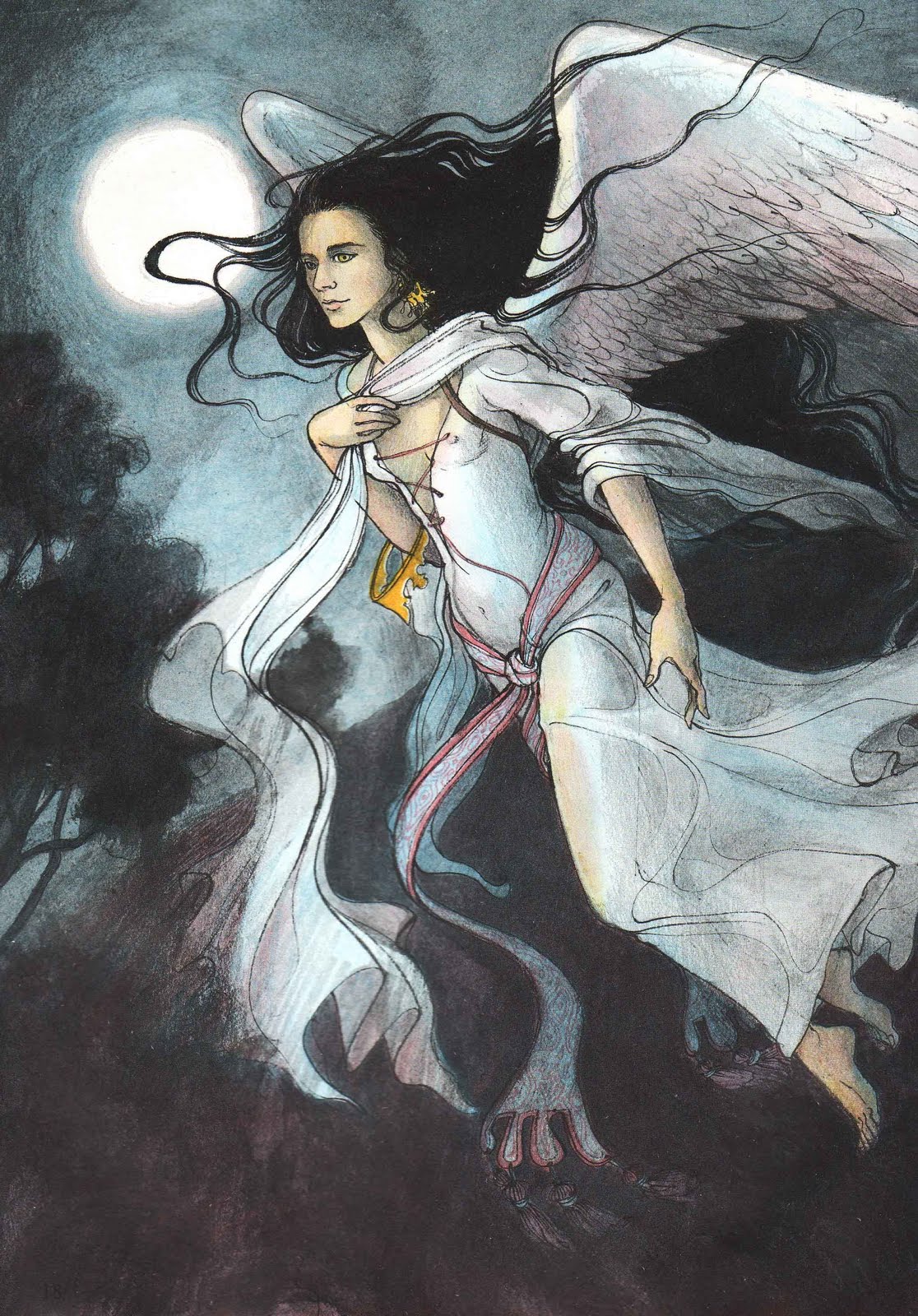
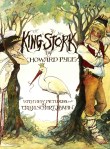
The fairy tale books we favour are those that at least have wonderfully dramatic illustrations. My favourite illustrator is Trina Schart Hyman, whose work illuminates and brings to life the wonderful fairy tale, King Stork by Howard Pyle.

Back to Pullman: my favourite story in the original Grimm book is in Pullman’s book too! It’s The Goose Girl.  A princess rides on her talking horse to marry a prince in a far land. On the way, her maidservant pulls off a coup of sorts, forcing the princess to change places with her and swear not to speak of it. The maidservant marries the prince and orders the horse killed for fear the horse will speak of her perfidy. The princess is made to herd geese and the horse’s head is mounted on the wall. The princess and the head converse from time to time and eventually things come to the attention of the prince, who tries to get the goose girl to speak of her troubles, but she has sworn not to and refuses. He tells her she can tell her troubles to the stove (!) as that would not be breaking her vow, and hides so he can eavesdrop on her. All is revealed. The goose girl is restored. The maidservant, who has apparently forgotten her own history, is asked what the punishment should be for a maid who has usurped her mistress’ place. Her verdict: the culprit should be put naked into a barrel studded with nails and dragged behind two white horses until dead. So that’s what they do. Awesome.

It’s not perfect, obviously. What kind of princess lets her maid take over like that? Why didn’t the horse stop the maidservant from overriding the princess? Weird. But then these old fairy tales are often full of inconsistencies and odd turns. They’re fairy tales, after all. Logic is not an essential. Good and evil, wrongdoing and punishment, magical flora and fauna, virtuous acts rewarded with a shower of gold and immediate elevation to royalty; that’s what fairy tales are all about. And Pullman’s versions are exactly that. In his own words: “I didn’t want to put them in modern settings, or produce personal interpretations or compose poetic variations on the originals; I just wanted to produce a version that was as clear as water.”

king3

2 Comments

Filed under Books

Some lighter reading: Paris in Love and Vinyl Café

After Sex at Dawn I took a break and enjoyed some lighter reading. Now I’m onto a book about World War II by Antony Beekov. I don’t know if I’m going to be able to post about that, it’s like 900 pages of small print on onionskin paper, but I’ll post about the light stuff:

51ihty1lg9L._BO2,204,203,200_PIsitb-sticker-arrow-click,TopRight,35,-76_AA300_SH20_OU15_Paris in Love is a memoir by Eloisa James. She and her family took a sabbatical year and spent it in Paris and it sounds just great. Books about Paris always make me want to shop and eat. Interestingly, Eloisa James is also a romance writer with very good reviews so I thought I’d download one of her books. I downloaded The Ugly Duchess because the title is funny and it’s very well written. I don’t read romances any more but I went through a period of connoisseurship when I was a teenager so I can tell a good historical romance when I see one. James’ book doesn’t seem as dense as say, one of Kathleen Woodiwiss’ novels, but it’s very witty and fun and is moving along briskly. (I feel a post on romance novels coming on….)

51APWP4S0AL._BO2,204,203,200_PIsitb-sticker-arrow-click,TopRight,35,-76_AA300_SH20_OU15_Vinyl Café is a creation of Stuart Maclean, a Canadian writer and radio personality. He dreamed up a typical Canadian family living in Toronto, and has a series of books which charmingly and hilariously relate episodes in their lives. These people get into more scrapes than Anne of Green Gables (another Canadian literary creation.) I wonder if that’s a Canadian thing. We just get into trouble, darn it. Anyway, these stories are laugh out loud funny so you can’t read them before bed, and not on a plane either. But I cannot recommend them highly enough. Maclean also has podcasts on CBC for download through iTunes, and I’ve been listening to them while I do chores around the house this weekend. If you download one, look for the names “Dave” and “Morley”. “Dave and the Bike” is a good one. The podcasts are of live shows Maclean has done around the country, so the first part is usually a lyrical talk about the history of the town he’s in, then there’s a musical interlude or two, then he gets into the story. So if you want to just hear about Dave and Morley then skip ahead until the last bit of music and applause stops. He’s a great speaker and storyteller. His podcasts kept me in a good mood all weekend despite payroll and laundry and changing bedding. “Stories from the Vinyl Café” is the first one, but the second one, “Home from the Vinyl Café” is even better.

Comments Off on Some lighter reading: Paris in Love and Vinyl Café

Filed under Books

My List: The Powerful Actors

Disclaimer: I’m having a light day. I’m going back to book reviews soon but am being self-indulgent and thinking about movies lately:

After my review of Les Misérables, I got to thinking about actors and how some actors not only have great range and ability to convey emotion, but can project power. Just standing, they have enormous presence – your eye is drawn to them and they effortlessly hold your attention. I wonder why that is but I can’t figure it out. What I can do is post a lightweight piece (I’m having a lightweight day) about my favourite “power” actors (I’m just dealing with men right now; I’ll deal with women some other time):

Russell Crowe: Obviously he comes first to mind as I just saw him play Javert in Les Mis. But when I think “power” I think of Maximus in the Colosseum, head slightly lowered like a bull about to charge, and murderous intent in his eyes. Power comes out of him in nearly visible rays. The soundtrack of Gladiator helps but Russell Crowe has tremendous presence and also a good range, which is a quality I’m factoring in here. Being able to look menacing isn’t enough to make the list. He has a somber face but when he smiles something happens in his eyes and you could knock me over with a feather. Cinderella Man? Master and Commander? This is why he is number one.

Serious Crowe

MV5BMTk1NjA3NDQ0N15BMl5BanBnXkFtZTcwNzM0OTE4OA@@._V1._CR342,0,1363,1363_SS100_

Happy Crowe

Denzel Washington: If I hadn’t just seen Russell Crowe play Javert I probably would have placed Mr. Washington first. He can be loud and raucous, he can be quiet and introspective, he can project suffering with liquid eyes (remember the whipping scene in Glory?),  he can do it all. He has a smolderingly dangerous presence, and even though he’s incredibly good-looking he has an everyman quality that is essential to place on this list.

Liam Neeson: Authority. Strength. Vulnerability. Even in Love, Actually he was a towering presence like an eagle amongst sparrows. When there’s an emergency, everyone will look to him. Like they did in The Grey.

Daniel Day-Lewis: Obviously. “Stay alive! I will find you!” And she did, and he did. I haven’t seen Lincoln yet but apparently he kicks ass in that too. And, of course, A Room With a View. Talk about range! Check! Everyman quality, check. Power, check.

Philip Seymour Hoffman: This is probably the third time I’ve mentioned that PSH should have played Henry VIII in The Tudors and it’s because he has the presence to play such a larger-than-life monarch. Henry VIII was a monster and megalomaniac but apparently he could also be quite charming and I think PSH would have conveyed those qualities very well. Jonathan Rhys Meyers, though gorgeous, doesn’t quite project the power that you need for this particular monarch. Nobody can do weary irony quite like PSH either, and every time I see him do it I get a thrill. Actually maybe it’s just how he’s feeling at the time. I just watched Mission Impossible III and I wonder if the ironic look on PSH’s face just is him thinking, “What am I doing here?” It’s hard to say. But he was wonderful in Patch Adams and The Talented Mr. Ripley and Doubt and I haven’t seen The Master yet but I hear he’s amazing in that too. That voice!

Eric Bana: He actually did play Henry VIII in The Other Boleyn Girl, with some success. Again, Henry VIII was a gingery blonde, very fair. Casting Eric Bana is another attempt to make the Tudors hotter than they actually were. I know that when he was young, Henry VIII was strong and handsome, but he spent 20 years with Katherine of Aragorn; by the time he took up with Anne Boleyn he was already getting pudgy and he was damn near forty. Sorry for the digression – at least Eric Bana has the power that you need to convey the majesty of the throne, and a monarch as willful as Henry VIII. What about Munich? Pow! Amazing. Hulk? Also amazing. He can do charming, he can do menacing (Star Trek!), and he’s able to be vulnerable as well.

Daniel Craig: The only Bond to make this list. I love Sean Connery but he’s not as dangerous as everyone else here. DC is the suffering Bond, the yearning Bond, the less-smooth but more-compelling, rougher-round-the-edges Bond.

George Clooney: He held everyone’s attention in ER and that was just the start of it. Natural authority, big presence, ability to convey a wide range of emotions and thoughts, and although he can look devastating, he also has the everyman quality. (Denzel Washington did a stint on St. Elsewhere, it can’t be a coincidence.)

Christian Bale: He’s been around a long time and has displayed a wide range already, otherwise I’d put him in the “Growing Into It” list. In Empire of the Sun, when he was very young, he was riveting. He’s still riveting and has anyone else noticed that he looks like the young James Brolin?

Matt Damon: Good Will Hunting showed Matt Damon’s range in just the one film, and that was the first really notable thing he did. Since then he’s sought out interesting roles and he’s really grown into a figure with a presence. His Jason Bourne, though at times a stony-faced automaton dealing out death, also shows wonder, pain, longing, all the vulnerable emotions that land an actor on this list.

Ray Winstone: Although Mr. Winstone is not as well-known as the rest on this list, I think he has quite a presence! He’s one of a group of older character actors whom I adore: Ian McShane, Ben Kingsley, Brian Cox, Tom Wilkinson, Chris Cooper, Gary Oldman, Mark Strong, Geoffrey Rush…the list goes on.

I also have to add Chow Yun-Fat and Ken Watanabe; because they’re Asian actors, their exposure in Western film is less. However, whenever I have seen them on film (Crouching Tiger, Hidden Dragon; The Last Samurai, Memoirs of a Geisha, Batman Begins, and Inception) they have both demonstrated the range, power and versatility of everyone else on the list.

Growing Into It List: these are the actors who are still evolving – they belong on this list but they’re not quite in the same league as my men above. Almost there but not quite…it’s just a matter of time and exposure and opportunities.

Mark Wahlberg: Talk about everyman. MW is a tightly coiled spring in the body of your ordinary guy. He can be tarted up and is devastating when he wants to be, but he has the ability to be anyone. I haven’t seen him do period yet and I doubt I ever will, but it would be interesting. Maybe Steinbeck or Hemingway as opposed to Brontë or Austen.

Ben Affleck: I don’t think he really found it and brought it until The Town. But The Town was amazing, one of my favourite movies ever. I think his strengths are perhaps more as a producer and director even though he is a very good actor. Can’t wait to see him do more challenging roles.

Jamie Foxx: The power is there, but as yet unleashed, so to speak. The range is nearly there but I haven’t seen Django Unchained yet so maybe it is there and I just don’t know it. My bad. But his performances in Ray and Collateral were stellar, in my opinion.

Robert Downey Jr.: He’s nearly there but so glib. There’s a lightness and wittiness that gives him membership on another list. Why? The characters he’s been playing have been limiting him. Sherlock Holmes and Tony Stark tend to intellectualize everything, suppressing emotion and holding it at bay, thus reducing opportunities to emote in any meaningful way. It’s not that I don’t think it’s there, it’s just that in movies like Iron Man and Sherlock Holmes it’s just not evident. It’s all wit, facetiousness and sarcasm. Fun, but not powerful or earnest. I’m talking in film, in what I’ve seen. Maybe he’s done something with tons of earnest emoting but I haven’t seen it.

Sam Worthington: He’ll probably top my list in a year or so. Brimming with potential but still quite young and kind of stagnating in the “Titans” movies. But he’s going to get there, I feel it.

Leonardo DiCaprio: I still think of LDC as a “young” actor, I don’t know why. As he ages he looks more and more like Jack Nicholson and he is tremendous actor. But this is my list.

Who isn’t on the list and why? I know; part of the reason I started this list is because I was watching MI: III during my workout and wondering why Tom Cruise, though fun to watch, does not have the same aura that Russell Crowe does. And Denzel Washington, and on and on and hey I think I’ve got a blog post here. Why not Brad Pitt? Why not Colin Firth? Hugh Jackman? Kevin Costner? What about Clint Eastwood and Al Pacino? I have my own criteria and not everyone made the cut, even though I think these are all amazing actors. Empirically, they are. But the essential qualities were 1) powerful presence, 2) range, 3) everyman quality and not everyone has that or has had the opportunity to showcase said qualities. Or else I just haven’t seen the film that would have landed them on my list. It’s subjective. Basically, I took everyone I could think of and tried to mentally cast them in Gladiator as Maximus, the quintessentially powerful yet vulnerable character. And period, to boot. It’s quite a fun exercise. Some work; some make you laugh out loud. Picture Hugh Grant as Maximus. See? But everyone on my key list could play Maximus. Oops, except for Philip Seymour Hoffman, but he could be king, so.

I thought hard about Clint Eastwood. I love him but his range of expression tends to go from Generally Annoyed to Detecting an Escape of Sewer Gas and not much else. I think it’s an old-school thing. My father-in-law has the same two expressions, very Clint. I’ve been trying hard to remember the end of Million Dollar Baby but I really don’t remember Clint’s expression changing much. He still looked pretty flinty at Hilary Swank’s bedside when any other human being would have been sobbing and howling with grief.

It’s a repressed thing. There’s emotion there, but it’s being repressed. Personal anecdote: I remember having the same look on my face after my father died. I suppressed my grief because I needed to be there for my mother and sister, and I didn’t dare indulge in the swelling of sorrow I could feel in my chest. I pushed it down ruthlessly, fearing that if I should allow a chink in the dam, the flood of grief would inundate me, drown me, and I would never be able to come back to any kind of equilibrium again. It literally felt like being at the edge of the abyss; if I allowed myself to feel the emotion I would tip over and never stop falling. Outwardly, I had the same narrowed eyes and gritted teeth that Clint displays on a regular basis. My mother sent me to a therapist, eventually, and even then it took the therapist 4 hours to get me to experience the emotions I was so relentlessly bottling up. It’s an old-fashioned, self-protective response to extreme emotion: the stiff upper lip, the stoicism. And the fact that our culture valued this quality shows when you watch older films and actors. But nowadays our culture allows us to emote and feel what we feel, and it’s ok, and we like that reflected in the films we watch. Every actor in Les Misérables had tears in their eyes at some point or other, if not constantly. In Gladiator, Russell Crowe emotes grief in a heartrending scene when he discovers his murdered family. I remember being shocked the first time I saw that. It made my chest hurt. You wouldn’t see Clint doing that. But it was raw, it was real, it was incredibly powerful, and that’s why Russell Crowe is at the top of my list.

Comments Off on My List: The Powerful Actors

Filed under movies

Les Misérables, sniff sniff

After the Oscars, in which the cast performance from Les Misérables nearly brought me to tears (I know, I know) I texted a friend to see if she wanted to go see it in the theatres. We’d gone to see The Hunger Games together and have a good cry, and it was tremendously satisfying, so we thought this would be great fun too.

Les Misérables

I’d seen the stage version, and while the music was good it didn’t really move me and I think I actually dozed off in some of the recitatives. I have not had a lot of luck with live musicals in general – I find the actors too far away for me to perceive any emotion in them, and in their efforts to project emotion they’re forced to the front of the stage to squall at the audience. I find this embarrassing. This is my fault; I love movies so much I think I’m conditioned to have expectations of close-ups and plots that move along with lightning speed. Also, when I was in my first year of university I bought seasons tickets to the opera with my cheap student discount. The opening night opera was a modern one set to a novel by Dostoevsky (if memory serves) and took place in a Siberian prison. I was in my first year of university and exhausted all the time from the course load and working to pay for it all – so my response to being warm, and in the dark, and in a Siberian prison – was of course to fall asleep. That set a pattern. I think I spent the entire season snoozing in the plush velvet seats of the Orpheum. I think I slept through The Marriage of Figaro, which is a great opera, but let’s face it, it’s four hours long.

The advantage of course of live stage productions is that there is an intermission so you can go pee – if you see the movie, it’s also 3 hours long and so gripping you don’t want to leave for the bathroom. Also the entire theatre is weeping so it’s fun to be part of that. Anyway, we were bursting by the time the movie finished. I’m amazed there was any water left in our bodies to excrete as we were weeping so copiously but there was a mad dash for the loos as soon as it was over so we weren’t the only ones. When you have a jumbo pop in a three hour movie with no intermission what do you expect?

Obviously, we loved the movie, and I did prefer it to the stage productions I’ve seen – sorry! I know it’s not very purist of me, but there you have it. It makes a big difference when you can see the actors’ faces close up, and they don’t have to do “big” emoting because of it. They can sing more intensely and passionately because they don’t have to project so far. I’m impressed that they recorded the singing while filming, so they weren’t dubbing in later, and they all managed to imbue the songs with so much emotion and feeling that it was all very touching even to a cynic like me. Eddie Redmayne, Amanda Seyfried and Anne Hathaway have amazing voices and they sounded trained to my admittedly not professional ear. Russell Crowe’s voice is as furry as he is himself, and while he sang well he didn’t have the same clarity and precision as the others. However, he is such a forceful presence that he made an amazing Javert. Hugh Jackman made a powerful, sensitive Valjean and he emotes like a madman. He, Amanda Seyfried and Anne Hathaway all have these huge liquid eyes that they’re able to fill with pain, and sorrow, and joy and every other required emotion. It looks really easy when  you have those enormous eyes. All the actors (excepting the comic ones and they just didn’t have the opportunity in this category) have the quality of vulnerability which came across in film and I think would have been missed on the stage. Is Eddie Redmayne the most incredibly vulnerable-looking actor or is it just me? I spent half the film wondering how he makes his lips tremble like that. Amanda Seyfried’s clear blue eyes and even clearer soprano can melt you like chocolate in a toddler’s hand. You just want to put them all in your pocket like so many kittens.

Sacha Baron Cohen was such awesome fun in his role as the innkeeper Thénardier, which I expected, but it was surprising nonetheless, because he was so good. I liked him better in this than I did in anything else I’ve seen him in (I don’t like his films in general). I thought it was brilliant casting but he was so good it was still a surprise. Helena Bonham Carter is fabulous in everything she does (I’ve loved her since A Room With a View) and she really sucked the marrow out of this particular bone. I love the actors with the versatile faces, who can look beautiful, but tweak their hair a bit, fleck them with makeup and they look totally insane. HBC is definitely one of these and she brings it on in this role. Hugh Jackman was also good in this respect – he is empirically good looking, everybody agrees, but in the opening scene, when Valjean is an enslaved prisoner, he’s almost unrecognizable. He seems to physically manifest pain and agony. It can’t just be the makeup; it’s a gift. His unbearably poignant death scene unleashed a fresh torrent of tears from our audience; you could hardly hear the singing.

Three hours of melodic revolution later, we staggered out of the movie, into the loo, and out again, our makeup smeared and the fronts of our shirts speckled with popcorn bits. Then we happily headed down to Hapa Coal Harbour and had a light post-show meal.

I’ve been on iTunes comparing the vocal performances with the original Broadway cast performances and overall, the Broadway ones are better, although Anne Hathaway, Amanda Seyfried and Eddie Redmayne are contenders. Interestingly, in comparing Russell Crowe’s “Stars” with the Broadway version I actually preferred Russell Crowe’s, go figure, because the stage voice seemed less masculine than Crowe’s – as anybody’s would, let’s face it – so the casting agents were definitely on to something. Conclusion: I enjoyed the film version much more than I did the live version. Close-ups and scenery pack a real punch and you just can’t do it all on the stage. I don’t know if I’ll purchase any recordings, mostly because I can’t hear some of these songs without crying and that would disrupt my day. There’s a time and place for everything.

6 Comments

Filed under movies, Music

Samurai and Ninja

Our kids take Japanese language lessons. They’ve been learning the language since they were two when they started at an immersion preschool, and we’ve always had Japanese-speaking babysitters. Now our Japanese-speaking sitter is more of a tutor which is good because I don’t speak Japanese at all. My husband does speak Japanese, after ten years in Japan and another ten years of arguing with Japanese chefs in our restaurants.

The teachers in the school are lovely, and the girls enjoy their classes. I’m amazed by what they are learning – my 9-year-old is already learning kanji, the complicated characters that express an entire word or concept. There are many strokes to each character and you have to do the strokes in the right order.  They also learn about Japanese customs and traditions and history. It’s great.

Japanese schools are big on parent participation, which is fine, except that I never know what’s going on and just stand there with uncomprehending eyes and a frozen smile while I wait for Justin to translate what’s going on. Everyone else speaks Japanese – at least the moms do (when there’s a caucasian dad who speaks Japanese he usually speaks it a lot just so that everyone knows that he speaks the lingo – show offs).  Many of the kids are half-Asian, with a Japanese mother and a Canadian father, so these sessions work for them, but they don’t work for me. So I attend, reluctantly, and am constantly mystified.

Yesterday’s demonstration was no exception. The topic they were expositing was “Samurai and Ninja.” Or, “Killers and Assassins” to my western mind. Totally appropriate for kids age 6-10! But Samurai and Ninja! Pretty exciting. I’m sure people were disappointed that there was no hara-kiri (ritualized suicide) demonstrations but time was limited, so. We did learn what foods samurai and ninja ate (yes to rice and fish, no to hamburgers and spaghetti). Then the kids recited Japanese tongue twisters and the adults were encouraged to also recite tongue twisters (me, frozen smile, polite refusal). I don’t know what this had to do with samurai or ninja but a lot went over my head.

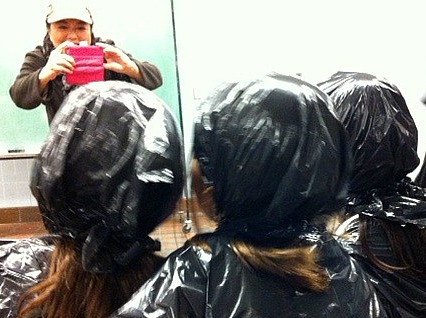
The climax of the demonstration was when we used black garbage bags to make ninja costumes for the kids. It’s basically an engineers’ raincoat: you cut a hole for the head and arms, cut a strip off the bottom for a belt, and you’re good. We made ninja headgear with a garbage bag cut in half and then folded into a triangle. Laid atop the head across the forehead with the point to the back, and then the sides folded against the cheeks, crossed under the chin and tied behind the neck, they were adorable.

One small thing I noticed though. I’ve seen The Last Samurai and I’ve read Shogun, so I figure I pretty much know everything there is to know about ninja. I could be wrong, but ninja were quiet, right? Because you never heard so much rustling in your life. It was the sound of an army walking through dry autumn leaves. These ninja could not sneak up on a marimba band. So I’m guessing the garbage-bag costumes were not exactly authentic. But like I said, I didn’t really understand everything that was happening.

But they were so sweet:

Ninja

I didn’t want to have the kids’ faces in here for obvious reasons.

So: we learned that ninjas didn’t eat spaghetti, it’s fun to see your kid dressed as garbage, and I didn’t have to perform a Japanese tongue-twister.

2 Comments

Filed under daily deedle-deedle

The permeable membrane of the English language

Apparently it’s ok to tell people to shut up now. If someone says something even mildly amazing, you can yell, “Shut UP!” Stacey London does it on What Not To Wear. I understand that it means “No way!”, but I’m still uncomfortable with this particular usage. I’m trying to prevent my children from picking up too much slang or disrespectful speech, even with their friends, because children don’t know when it’s appropriate and not appropriate. With friends, appropriate. With adults, not so much (slang!). I find it counterproductive when adults are too jocular with kids because they blur the line between “adult” and “friend” and encourage the children to be impertinent. I think kids should know the difference and adults should help them. That’s why we use “auntie” and “uncle” when the children address close friends. It’s disrespectful for kids to address adults by their first names. We use this mostly-Asian solution, using family titles as terms of respect, as opposed to family relationships. Anyone else we use “Mr.” and “Mrs.”  I know it’s more common for kids to use adults’ first names, but I think that what our society needs is more formality, not less. “Shut up!” is so informal that I’m really not comfortable saying that to people. But it’s becoming more and more common and one day I’ll tell my Grandmother to “Shut up!” and then the lengthy explanation and apology. It’s all about the inflexion, but I don’t know if Grandma would get that subtlety.

I understand how difficult it is to prevent certain words and expressions from entering one’s permanent lexicon. I’m still saying “dude” and I’ve been trying for ten years to eradicate this one word from my vocabulary. Very frustrating. I’m still using English expressions from my year in England and exposure to English friends. “Taking the piss” really doesn’t have a North American equivalent, but it doesn’t sound good in North America. (My mother-in-law hates the word “piss.”) Thank goodness that you cannot, I think by law, use “blimey” if you are not actually English or I’d be trying to delete that from my vocabulary also. When you want to delete curse words from  your vocabulary it’s handy to have substitutes and “blimey” would be great if it were possible here in Canada. But I don’t need anyone to tell me it’s not.

My mother always spoke very correctly, so when I was growing up, so did I. I was teased by my cousins for being ladylike, which they found prissy, so to counter this impression I picked up whatever vulgarity was going. I still tend to speak very casually to new acquaintances because I want to seem “approachable” – apparently I give an impression of unapproachability. It’s not intentional; like Ringo Starr, “it’s just me face” and the fact that I don’t like big parties. When I get emotional enough to forget myself, such as when angrily critiquing the series The Tudors, the hyper-articulate, precise language comes out again. The adoption of lowbrow language, however, as a long-term strategy, has its pros and cons, to say the least. Mostly cons. It’s very difficult to stop swearing once you’ve started, like smoking or colouring one’s hair. Not to mention, I’m one of those people who get excited when someone says “excape” instead of “escape” or “nucular” instead of “nuclear”. Hypocritical, I know.

I picked up “dude” and “buddy” from one of my sister’s boyfriends. He was a rave promoter and his comfort zone was about as far from my comfort zone as you can get, although he is a very good person. Even though my sister was at school in Australia he’d come by to help me do things like assemble Ikea furniture and would periodically insist on taking me out clubbing. I’m the kind of person who likes to be in bed by nine with a cuppa, and I don’t really drink, so it was a definite novelty and I enjoyed these excursions. It was certainly diverting and educational and yes, there’s a bit of sarcasm there. For my part, I gave him reading lists, cooked him the occasional healthy meal with vegetables, and tried to encourage him to clean up his language, which was execrable. Instead, I picked up his! The least of it was “buddy.” “Buddy” is actually a rare Canadianism, from Newfoundland, so how it found its way to British Columbia I don’t know, but it’s quite useful, if vulgar. Instead of saying “that guy” you just say “buddy,” as in “Buddy over there just stole my parking spot!” However, it’s not particularly refined language and I’m trying to clean up my act so I’m deleting “buddy” from my vocabulary. I’ll miss buddy.

Another hard-to-erase vulgarity: when I lived in Malaysia, we had friends from all over the world, one of the best things about being an expat. One set of particularly good friends were from Kentucky and Tennessee, so of course we picked up “y’all” which I figure is basically equivalent to the French “vous”, which translates to the plural pronoun “you.” There is no English equivalent unless you’re a Southerner. It’s taken me about ten years to eradicate “y’all” from my vocabulary and I have to say, I miss it. When you are talking to a group of people in the northern 70% of North America, you have to make an extra indication as to whom you’re speaking. I moved to England directly after Malaysia, so of course I was saying “y’all” to the English, to their amused disgust, whilst I picked up words like “whilst” and “gobsmacked.” Say “gobsmacked” in a North American accent, deadpan, with a touch of irony. Funny, right?

The other thing I noticed whilst in England (see how hard it is to give up words?) was that the higher up the social ladder you are, the more freely you curse. Mind you, right at the bottom of that ladder the cursing is equally abundant. In the middle, where people are still striving for upwards class advancement, people are super-careful about their language, it’s like a hallmark of the lower- to middle-classes. I guess at the top and bottom you just don’t care. Although it has to be said that cursing is more common in England (they say words we really do not say and you know which words I’m talking about) and people don’t seem bothered by it the way we are here in North America.  (This is anecdotal observation, not statistical, so I could be wrong, but this is what I observed.) I should have stayed in England and applied to become an aristocrat (there’s a form) because I can’t seem to stop swearing. I generally blame this on my father, or the rave promoter, but maybe I can I blame it on reincarnation, like the people who travel back to their past lives via hypnotism and start speaking Polish, or 11th-century Greek. I travel back to my past life as a salty-tongued English countess via the pain of a stubbed toe or the trauma of bad drivers. I revert to my past self and out comes the f-word, usually in the present continuous tense with “bloody” on one side and “hell” on the other. It’s a powerful phrase, what can I say. Why that makes us feel better, I don’t know but I think there are studies showing this is true. Still, I’m working on it. I’m auditioning substitutes, methadone curses, like Steve Carell in Evan Almighty shouting, “Mmmmmotherfathersisterbrother!” when he bangs his thumb with a hammer. This is how words like “shoot” came into usage. “Darn” when you’re mad. “Double-darn” when you’re really mad! Are these pale substitutes effective? Do they alleviate pain and frustration? Sadly, no. There’s nothing like the real thing. Sugar, nicotine, butter, heroin, profanity. Take “shoot.” It forces the mouth to form a “u” shape, whereas the original keeps the teeth gritted as they should be when uttering a curse. You can’t say “shoot” through gritted teeth. Try it. Try saying “darn” without feeling like a cowpoke. “Double darn” and you’re Gomer Pyle (unless you manage to inject enough irony into it). Oh well. But like methadone these toothless curses serve a purpose, to wean people like me off the terrible words of power we cannot seem to stop uttering. And don’t get me started on the invocation of deities. Jesus doesn’t know where I left my keys but I call His name anyway when I can’t find them. Yelling “God!” when you’re frustrated probably just calls His attention to your bad behaviour. I’m not religious, but it’s funny how Holy-Mary-Mother-of-God comes to my lips when I’m exasperated.

Anecdote: I was driving with a child in the car and a driver nipped ahead of me, cutting me off, then proceeded to drive 40k in a 50k zone. Why do people do that? I started saying, “Gah I hate – ‘” then cut myself off because I could feel the f-word rising up and wanted to quell it. From behind me a little voice said, “It’s ok to say ‘hate’ when somebody’s driving bad, Mama.” I was surprised: “Oh, really? ‘Hate’ is ok?” Little voice: “Yes.” (or “Yeth.”) So I drove for a minute and then the little voice spoke again: “Also ‘asshole.’ That’s ok too.” Um, okay! Thanks for the licence! Because I was really hating that asshole for cutting me off and driving so slow and it was nice to know I could express myself accordingly. But I know, I know. We had to have a talk about that and I promised myself, again, that I would stop swearing.

Apart from the swearing thing, a lot of my usage comes from British influence, mostly books. Obviously. There are reasons, it’s not affectation like Madonna suddenly adopting an accent. I don’t call cigarettes “fags”, and I don’t say “reckon”, but when I say “cuppa” you know it’s tea because we don’t drink coffee around here. I don’t say anything that might confuse people, like “jumper” or “cooker” or “boot and bonnet.” There’s no gain in that. But I say “flat” because “apartment” is a longer word. I say “you’re meant to” instead of “you’re supposed to” because that’s shorter too. I love “not a bother on her” although I don’t know if that’s English or Irish. Being Canadian, we’re sort of straddling the line between American usage and British usage anyway, so I figure my usage goes under the radar. Also, many British expressions sound funny when you say them in an American accent but really deadpan or with inflected quotation marks. See above, gobsmacked.

Obviously globalization has had significant impact on the English language: “kawaii”, the Japanese word for “cute,” is in fairly common use here in Vancouver. When you hear people whose English is their second language speak, you can hear the slang that comes from all over the English-speaking world. Our Japanese chefs say “no worries” which I think they got from me – and I got it from living in Australia although I could have acquired it from watching Crocodile Dundee or hanging out with Aussie surfers, like everyone else. It sounds super-funny in a Japanese accent.

The flexibility of the English language allows me to adopt words that I find useful and convenient to my daily speech and that assist in my ability to express myself. Other languages have words that express concepts that are universal, yet have no English equivalents. The German “schadenfreude” – the pleasure one gets from the misfortune of others – is a classic! My favourites come from my frequent exposure to Japanese: “shoganai” means roughly, “it can’t be helped” or “what are you going to do?” in the face of adversity. It’s fatalistic, stoic, philosophical – so Japanese, but it’s a great expression, the equivalent of the French shrug, although the two have their differences in that the Japanese one is a kind of cheerful “oh well!” whereas the French one (in my experience) is a gloomy “Oui, we’re out of bread, so what.” “Gaman” is a concept based on perseverance, fighting, working hard. “Ganbatte!” means “Go for it!” “Otsukare” partners with “ganban” and means “Good work, you’ve been working hard!” Isn’t that nice? Another favourite is “genki” which means energetic, healthy, happy – a combination of all three and the possession of which helps with the ganban and the shoganai. Obviously I don’t use these words with those who are unfamiliar with them, but within our household and in our business, they are very useful. The girls are taking French Immersion and I’m pretty sure I’ll be adding French expressions to my vocabulary. Already we use  “Voila!” (here it is! but it sounds better in French and really facetious in an English context when said with a self-mocking expression); “c’est bon” which just means “good” but we use it because it sounds funny, especially when you pop the “bon”, and “n’importe quoi” (it doesn’t matter, it’s not important) which we use because it sounds better than “whatever”. Most Canadians use the French we have (severely limited for the most part) with more than a touch of facetiousness and sarcasm, because a) otherwise it’s soooo pretentious, and b) it’s the only way we can pull it off with our terrible accents.

For better (emphasis or humour) or worse (laziness), my personal lexicon embraces profanity, foreign language, foreign expressions, vulgar expressions, outdated language, and I still think of myself as fairly well-spoken, and I think that goes for most of us. We English-speakers can understand English words in many accents (unlike French and Japanese and some tonal languages where if you don’t get it exactly right they pretend not to know what you’re talking about), we incorporate idioms from everywhere, we constantly invent new slang – it’s an amazing freedom of speech. I’m so glad I speak English! I can get away with this attitude: if it says what I want to say more accurately, or more efficiently, and if my audience understands me, I’m using it. C’est bon!

But not “dude.” That’s going, along with the cursing. Wish me luck, y’all!

Comments Off on The permeable membrane of the English language

Filed under Popping off about something random

Game of Thrones and fantasy literature, especially LOTR

A couple of years ago my sister told me to read Game of Thrones, by George R.R. Martin. She promised me I’d love it. So I downloaded it onto my Reader – there was a 4-book set and the fifth newest book, yay – and there it stayed for well over a year. I didn’t know anything about it except that it was fantasy literature and I was mildly deterred by that knowledge – sometimes fantasy can be hard to deal with. You have to suspend disbelief to enter a whole new world, complete with mythology, history, speech patterns, languages, names. It’s a lot. In my experience, the best fantasy literature uses known culture as a framework on which to drape the imaginary world. This facilitates acceptance and understanding so that you don’t confuse people with too much new stuff. Like bizarre names, for instance. The toughest fantasy lit takes you FAR from your frame of reference and usually thrusts upon the reader too many new nouns, usually names. The Silmarillion comes to mind. Interestingly, The Lord of the Rings and The Hobbit are very grounded in western idioms, which make them accessible, yet Tolkein goes nuts in his other books and even though there’s still a discernible Celtic influence (fantasy authors love the Gaelic), he falls victim to his love of linguistics and it’s a veritable avalanche of names and languages. People who love LOTR and The Hobbit try The Silmarillion and are usually defeated by it, me included. I will say, I love LOTR and the Narnia series. I’m one of those people who periodically re-read LOTR and sat there in the movie saying things like, “That didn’t happen in the book.” I also love Ruth Nichols’ books A Walk Between the Worlds and The Marrow of the Earth which you can’t even get anymore except from alibris.com but they are wonderful.  Lian Hearn has done an amazing job with his (her? – Hearn is a pseudonym) Across the Nightingale Floor series which is a similar parallel-world fantasy based on Japanese history, geography, and legend. Again, there is a grounding, a familiarity which makes the fantasy world easier to understand and care about. I’m also enjoying fantasy literature that is located on earth, but incorporates magic and fantasy, such as Erin Morgenstern’s The Night Circus and Lev Grossman’s books The Magicians and The Magician King. Fantasy, and we didn’t even have to leave Earth. Well, we do in the Grossman books, but still. (I hear there’s a third book coming out, yay!)

Generally though, I’ve found that most fantasy literature omits aspects of life that prevent the “world” from becoming fully realized. Lord of the Rings in particular, has a simplicity that helps the narrative flow and makes the plot easy to understand. Its simplicity conveys powerful emotion and the reader becomes vested in the outcome. But let’s face it, Middle-Earth is not a fully functioning world. There is a lot missing. Religion, for example. There is no religion whatsoever, institutionalized or otherwise. What do the hobbits believe in, besides gardening, pipes and beer? There’s no hobbit deity? No hobbit church? That’s odd. What do they do when tragedy strikes? When bad things happen, many people need to believe in a benevolent deity in order to get through the pain and survive. We need to believe that someone is looking out for us, that justice will be served in the next world, because it clearly isn’t being served in this one. We need to have some belief in an afterlife. We need to believe that we’ll be reunited with loved ones, and that the inexplicable phenomena that occur in the world are designed by a deity who may be harsh but loves us anyway and is just teaching us a lesson. Maybe. Well, I don’t, but lots do and it’s fine, I’m not criticizing. But what’s up with the hobbits? Are they just so down-to-earth and practical – and, frankly, dull – that they don’t look to a god to help them when times get rough?  They are very English so maybe the stiff upper lip is good enough, but it’s hard to believe. Often the simpler the folk, the more they need religion to explain the inexplicable. Which brings me to the Rohirrim. Remember, the people with the horse culture who inhabit the steppes and are essentially Saxons, except without the Horse God which seems like a big omission. They don’t seem like a very literate people, so you’d think superstition would be rampant, no? Apparently not. The elves are practically gods already, and seem to be held in some reverence or superstitious fear by the other inhabitants of Middle-Earth. They’re pretty godlike already. Smart, gorgeous, immortal, kind of detached about stuff the rest of us care deeply about. The end of the world is imminent but they’re all going to emigrate to some sort of Elysium overseas, no worries. The most goddess-like character in the whole book is Galadriel, who definitely comes across as powerfully divine. Yet she isn’t worshiped as a goddess and even rejects the opportunity when offered the Ring. Remember when she roars, “All will love me, and despair!” Awesome. But ultimately she’s not interested. So definitely no religion, even when there are ready-made gods available, if unwilling, for worship.  Interesting. I think the introduction of religion was dismissed as distracting to the overall story.

What about the economy of Middle-Earth? A certain amount of trade is inferred but it is of severely limited scope. Goods from the Shire make it across Middle-Earth, at least as far as Saruman’s domain, but other than that we don’t get a sense of an economy, of trade, and how that economy is impacted by war. What about agriculture, besides the hobby-farm type popular in the Shire? In the movies, the absence of farming communities makes for a stark and dramatic landscape, but what do these people eat? In the battle of Gondor, you have the walled city and then just barren land all around? No way – that would be inhabited and farmed and full of shops and businesses thriving because of their proximity to the city – in the real world. But in Middle Earth? Nothing, not even refugees. What about small business? Entrepreneurship? There’s one inn, at Bree, but that’s it. Barliman is the sole businessman. There’s no big business either, obviously. There must be industry somewhere, because the hobbits’ houses have glass and metal features to them, but not only is there no sense of it, but the evils of industry in the Shire are shown as a warning to Frodo as what will happen should he fail in his quest. So clearly the ideal is the pastoral life. There isn’t even a sense of a basic social structure like the serf system of medieval Europe. The Shire has agriculture but no serfs and obviously no machinery. Elsewhere, there’s the lord, or king, and everyone follows the lord, usually to war, but there is no politics, none of the alliance-building and ulterior motives, the double-crossing and secret pacts that characterize human political systems in practice. There are no powerful families or groups that need to be bought or appeased, or threatened, into compliance with the lord’s agenda. Again, more streamlining.

I mean, I get it. That stuff can detract from your story, and it can be kind of boring. We prefer the struggles of princesses, and magical beings, and prophecies being fulfilled. We love that stuff. But it can make fantasy a somewhat thin genre. The standards of good fiction just don’t get fulfilled in a lot of fantasy literature, that’s all I’m saying.

For instance: how many fully realized characters do we enjoy in LOTR? Frodo, Sam….that’s about it, and I’m being generous with Sam. The hobbits in general are a pretty plain and unimaginative people, essentially cultural philistines. I mean, nobody even reads, except Bilbo, and he’s regarded as an odd bird. (I relate to that.) Gandalf, maybe? The obsessed Smeagol? Character depth comes from internal struggle, with the growth of the person, with revelations of the character’s history to give insight into the character’s motivations. There’s not a lot of that in LOTR, even for the major characters. You can’t get away with that in conventional literature!

The big thing in LOTR is choices. Frodo’s choice to carry on with the destruction of the Ring, Arwen’s choice to marry Aragorn and live as a mortal queen, Smeagol’s choice to betray Frodo, Sam’s choice to take up the Ring and keep on truckin’. And the consequences thereof. But all the other characters are very basic or else just cannon fodder. Orcs? What do they want, really? Just to kill and destroy? Are they just puppets? I can’t believe that. What is their motivation? Roman soldiers were promised land, farms, in return for their service. What are Orcs promised? I don’t see orcs farming. Sauron is just an evil entity, the burning eye in the sky. Destroy, destroy, ya da da. All he wants is to kill everyone in Middle Earth and preside over the blasted landscape? Sounds like a partay! Come on. Even North Korean dictators take a break from the evil to enjoy a good movie now and then. And most evil monomaniacs are interested in personal gain so they can buy Lamborghinis and Loire chateaux and hire celebrities to attend their birthday parties. It’s not like Sauron’s after riches that he can squirrel away in a Middle-Earth Switzerland so that he can send his kids to Middle-Earth Eton and go gambling in the Middle-Earth Macau – although I’d like to see that. (Can’t you just see Sauron at a party at Hef’s mansion?) He’s just a force of darkness with apparently no pleasures in life. Sad, really. Poor Sauron.

So where am I going with this?  Game of Thrones, which rejects the tendencies of most fantasy literature and is so incredibly realistic that it blew my mind. Realpolitik! Changing allegiances, double crosses, spies, dark horses that come out of nowhere and mix it all up, new opportunities to complicate things…It’s brilliant. Complex human relationships. Real motivations. Conflicted characters. Characters who grow as people, learning and developing. Wow. Plus magic, dragons, supernatural beings and what have you just to make my cup runneth over. Competing religions! Sweet!

I don’t think you can get all this from just reading the first book. There is one character in the first book who seems irredeemably evil, but lo and behold, he gets to grow as a person and becomes a sympathetic character in the second book and thereafter. He’s not perfect – nobody is in GOT, that’s my point – but he develops a whole new facet to his character. Love it.

I’ve heard criticisms of GOT, about the violence against women in particular, and someone said something about “fake Welsh” which I thought was odd. GOT is definitely set in a European landscape. I don’t know how you can have a problem with that. It’s essentially England, but extended, so that the far south is almost Mediterranean in climate, and the far north is essentially Arctic. It’s medieval, time-wise, so I think that the level of violence is actually fairly consistent with that era. And it’s a time of war – violent by definition. The language is not chivalric language; it’s fairly rough but again I think it’s consistent with the “times,” so to speak. If anything these elements add verisimilitude to the story. Rape, looting, mayhem, bad language – it’s all part of war and not just medieval war either. So it’s distasteful but truthful and convincing.

Names of people, places and things are fairly straightforward and not tongue-twistingly complex, so it’s easy to keep track of who’s who, although there are so many relevant characters that when you start a new chapter sometimes you have to read for a while before you figure out who it is you’re reading about. Often they’re concerned with mundane matters such as food, shelter, warmth, the basics of survival in wartime. It’s quite amazing to have such realism built into a fantasy series. You see the impact of war on a countryside. Byproducts of war such as famine and disease are present. There are refugees! War needs financing – bankers show up to call in loans. All the trickle-down effects of war are felt in GOT.

Characterization: unlike the orcs and elves in LOTR, it’s not always easy to tell who is “good” and who “bad” – these are not stormtroopers in white armour. Ugly does  not equal evil. Even the idea of “good” and “bad” is not clear – good people do bad things, for their own reasons, and vice versa. I always liked Ken Follett’s spy novels because he always explained why the bad guys did what they did, so you could understand their motivation. I love that. I hate the evil-for-evil’s-sake bad guy. GOT is rich in this way; the characters grow and change and develop and surprise you, and it’s wonderful fun.

I first realized how involved I was with the series by my reaction when a major character was killed. I already knew that Martin does this – it’s part of the realism  that hooks you – but I was so shocked I had to put the book down and go do something else for a while. I had a physical reaction – sweaty, heart pounding, major anxiety – for a fictional character! I’m not going to spoil it here but I simply could not believe this character died. My expectations were conventional – that this character would last to the end. Not so! There are a lot of shockers like that in GOT. Just when you think you’ve got it figured out, Martin throws in a doozy of a plot twist or kills off someone important. There are also enough YAY moments so that you don’t get too depressed, thank goodness. There is religion, there is an economy – I love that there are bankers involved – there are different fairly fully-realized cultures that figure peripherally in the story and correspond roughly to Middle Eastern and Central Asian culture, and they have their own social structures and history and everything else.

At the core of the story is the Stark family and they are amazing, flawed and loveable characters. And I have to say, you cannot but care for these people. When I was in New York I was just starting the first book, and I saw in a market a t-shirt that had the Stark names on it: Robb, Sansa, Arya, Bran, Rickon (Jon Snow). And another one with their direwolves’ names: Greywind, Lady, Nymeria, Summer, Shaggydog, (Ghost). The ones in brackets were printed in a different colour to denote Jon Snow’s illegitimacy. See? Complex family relationships! Pets! I’m pretty cynical about fiction but I confess, it’s incredible how much I care about the characters in GOT. I kind of regret not picking up that t-shirt now. I’m not the “fan” type, but I love the dwarf Tyrion, I love the last princess of the Targaryens (you rock Dany!), I love the female knight Brienne of Tarth, I love the onion knight – you know who you are – and I’m even liking Jaime Lannister although I never thought I would. If you’re reading GOT you know what I’m talking about and you understand all this cheering and stomping.

Game of Thrones: my favourite new fantasy series. My only concern is, I hear that the series will run to 8 or maybe even 10 books. Part of me is excited about that, but I hate waiting.

End note: I’m enjoying the TV series but does it need that much nudity? If I hear my kids even approaching I need to shut it off quickly because they tend to start new scenes with gratuitous sex. I don’t think it needs it but apparently it gets the husbands watching too so I guess that’s something.

3 Comments

Filed under Books

Beethoven, Schubert…and the tragedy of age

I’ve played the piano since I was 7 years old; I’ve kept it up, on and off, ever since. I love music, I particularly love making music on the piano. It seems like magic, to move your hands and have this great sound come out. Brilliant. Lately I’ve been going back to the piano in a big way; partly because I’m trying new pieces in an attempt to understand what it is like to learn new music, because my daughter is having to learn new pieces every week. I was being impatient with her, frustrated by hesitation and pauses in the music, but I started learning some new stuff and now I get it. I think there is a difference between Leila Fletcher and Beethoven but there is also a difference between 7 and 43, so it’s all relative. Now when she hears me pause at a difficult spot she shouts, “No holidays! TEMPO!” and thinks it’s great fun. It’s actually quite useful, though, and I’ve become more patient with her as a result.

The irony of all this (besides my 7-year old enjoying revenge) is that now that I appreciate playing (thanks Mom!) I am getting creaky and I don’t have a lot of time to practice. When I was a teenager I was supposed to be practicing two hours a day and considered it a prison sentence. The outrage! Shackled to the piano, the suffering. But now I take advantage of every lull in my day to sit down and practice a few more bars, trying to perfect this incredibly difficult music with my pre-arthritic hands, which throb after I’ve been playing for a long time, particularly the fifth fingers. It just feels so good when I get a passage right and can fit it into the song and play it through – it’s the best feeling.

What’s with Beethoven and all the octaves? I’m working on the Allegretto of Sonata 17 and I love it, but the octaves are a killer. When I’m diagnosed with arthritis I’m blaming Beethoven. I try to listen to recordings to help me along but the recording I have of this piece is by Glenn Gould who plays at breakneck speed and I think they must have transferred this at 78 rpm because there’s just no other explanation for it. If you cough, you miss it. He plays a 12-page sonata movement in about a minute and a half. It’s unreal! Yes, he was a genius and possibly autistic, but still. I’m exhausted after learning two pages at my snail’s tempo. I love Beethoven though; the inevitability of the music, the way it rolls along, pulsing, it could make your heart burst with the joy of it. Sorry, rhapsodizing.

I’m also working on Schubert’s Sonata in A Minor, D537. It’s a lovely piece and only about 5 pages which is a relief. It’s played in A Room With a View, one of my favorite movies, which is one of the reasons I decided to try it, because it’s already so familiar. The tempo of the recording I have (Seymour Lipkin) is a reasonable tempo so this sonata actually feels doable. That said, I haven’t got past the third page yet.

I’m playing a Schumann’s Kinderszenen piece (Schumann, so charming) and some music I downloaded from movie scores (The Painted Veil, River Waltz) – for dessert and to rest the fingers. Like stretching after a workout.

Unfortunately our budget only allows for one of us to have piano lessons so resources have already been allocated but – I wish I could have lessons. I also wish I could effectively convey this feeling to my daughter so she would appreciate the lessons she’s having now. Why must it always be hindsight?  Why must we learn these lessons so late in life? I wish I’d appreciated the energy and time of my youth, not to mention my fabulous teacher, when I had them. (And when someone else paid the bills! My parents never talked about how expensive the lessons were, so they’re better people than I am.) Not to sound doleful about it, as I know how lucky I am to have a piano and a bit of time to play it and fingers still relatively dextrous (for now), but regret is a tough pill to swallow. If only there was some way to impart these lessons to my children.


1 Comment

Filed under Music