Yearly Archives: 2013

Christmas looms but there’s still time to read a few more good books

I’ve done all my Christmas shopping so I’m taking a minute to do a quick post, but the books I’ve read lately that I felt were noteworthy had to go back to the library!

(I know authors love to hear that. Not. Honestly, I would love to buy every book I read but a) I can’t afford it and b) there’s no room in my house for more books.)

Big Brother by Lionel Shriver. Lionel Shriver is a totally fearless writer and in this book she tackles the issue of obesity. The main character’s brother comes for a visit and has put on so much weight he’s unrecognizable. He’s become an obsessive eater, much to the alarm of his sister and her family. He actually breaks handmade furniture with his bulk. Shriver looks at the root causes of this character’s obesity and makes links to depression, the dangers of peaking too early, and self-worth. There were great paragraphs about youthful entitlement that I wanted to quote but I already owed the library major late fees. I actually don’t mind paying money to the library; I figure it’s going to a fantastic public service that I’m happy to support.

The Gates, The Infernals and The Creeps, by John Connolly. This trilogy is actually YA fiction, but I enjoyed it mightily. I’m a Christopher Moore fan, and John Connolly is essentially a British Christopher Moore. Basically, a Hadron collider opens a wormhole between Hell and a small village in England. Mayhem ensues. It’s very fun and witty, and I was reading bits out to my sister that made us laugh out loud and now she’s reading the series.

Merry Christmas everyone!

1 Comment

Filed under Books

Book Reviews in brief: The Golem and the Jinni, The Abominable, etc.

I have powered through a pile of library books and some, in fact most, have been absolutely wonderful. I’d like to say I bought them all but I can’t afford my own reading habit. There are some books I will buy for my Reader and then I hoard them for holidays and for reading on the elliptical machine. Right now Margaret Atwood’s Madaddam and Bill Bryson’s One Summer are on the Reader for when we go to Hawaii. Also G.J. Meyer’s history of World War I, A World Undone. Remember him? He wrote about the Borgias and the Tudors and I am a fan. But I thought I’d quickly run through some of the fabulous books that have kept me reading late into the night….

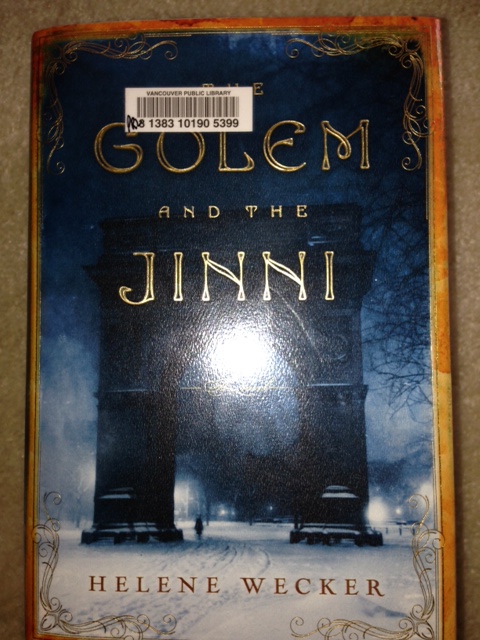
1. The Golem and the Jinni, by Helene Wecker. GolemI didn’t know what to expect from this book but from the first paragraph I was totally mesmerized and neglected my work and family so I could finish it. I think everybody’s enjoying this book because it took AGES to get from the library. I love stories about magical creatures finding their way in our world and in this novel a golem and a jinni find themselves in New York City circa 1910. I was rhapsodizing about this book to anyone who would listen, forcing my husband to look up from the sports pages, and found that I had to explain what a golem was quite a few times. I guess everyone hasn’t read Marge Piercy’s amazing book He She and It, and if you haven’t you should. Its main point is the immorality of creating a self-aware intelligent being for your own purposes and denying its right to its own life. In Piercy’s story a futuristic self-aware robot is created for the defense of a community, yet it has its own needs and desires. Interwoven with this narrative is the story of the golem of Prague, the clay man brought to life by a rabbi who also desires to protect his community. In Wecker’s book, the golem’s master dies within hours of bringing her to life and she arrives in New York masterless. Wecker just takes it from there and she does it beautifully. Thank you, Ms. Wecker, and please get right to work on your next novel. I’ll buy it.

2. We Are All Completely Beside Ourselves by Karen Joy Fowler. On the theme of intelligent self-aware beings, this book is about the fallout when a family that has adopted a chimp is forced to give her up. I heard today that there is a lawsuit in the United States being filed on behalf of a male chimp named, I believe, Tommy, which is interesting as it argues Tommy’s rights as a person, so the whole issue of personhood will soon be wrangled in the courts. This book is gripping and made me remember the films from Psych 101 with the signing gorillas and chimps. I didn’t really consider what would happen if one of them threw a grad student into a wall. If you raise an ape with a human family, they believe they are human. To then – even though it’s clearly necessary for everyone’s safety – send them to an ape research facility is incredibly cruel. It’s hard to believe that smart people like psychology professors don’t see the eventuality looming, but there you go. Fowler’s previous book, The Jane Austen Book Club, was a good read but this one blew me away. I needed to take a break after I read it so I could properly process and then I told the whole story to Justin. It’s ok, he wasn’t going to read it anyway. I’d love it if he would read more fiction, but you know. Horse, water, drink.

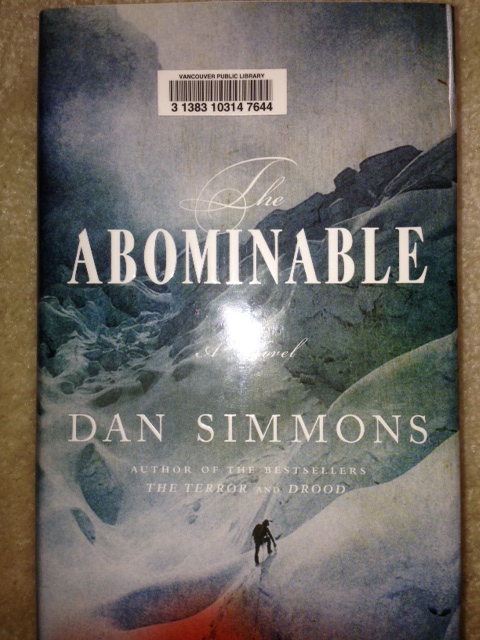
3. The Abominable by Dan Simmons. I just love books about climbing, even though you would never get me near a mountain. I’m fascinated by the thought processes of people who can’t wait to endanger their own lives and those of others in this totally unnecessary physical feat. Into Thin Air? Awesome, and it got me started on this genre. Abominable The Abominable is a novel about climbers in the 1920s and has a great spy-novel-ish plot. There are lots of minutely detailed descriptions of climbing that made my eyes glaze over a few times, but overall it’s great fun to read. It’s even more fun if you read it with Google Earth by your side so you can look up the Matterhorn and the Eiger and say knowledgeably, “Yeah, that north face does look pretty tough,” from your warm and cozy bed.

4. A Constellation of Vital Phenomena by Anthony Marra. I put off reading this book because it was about the Balkans and everything I’ve read about the Balkans has been devastating. Then the due date loomed and I was forced to and I was glad I did. This book is, unsurprisingly, devastating but it’s a very good read nonetheless. It’s one of those “small world” plots in which the main characters’ stories are entangled together but they don’t know it and the reader gets to put it all together. Layers of tragedy and irony. Cue the dolorous minor-key Chopin Nocturne.

5. Neverwhere by Neil Gaiman. Gaiman’s books are just pure fun. My seven-year-old watches a good movie with wide eyes and a big smile on her face (it’s hilarious) and that’s what I look like when I read Neil Gaiman. I think I’ve already established myself as a fan in a previous blog post. I love it when characters from our world encounter some alternate reality and are going along with the quest or whatever but their internal thoughts are, essentially, “WTF!” That’s so fun.

6. The Weight of Heaven by Thrity Umrigar. WeightofWater Another devastating tragedy, but beautifully written and so worth staying up late to finish. You know it’s well written when even though you know where this is going you still read on and on because every word is worth savouring. Then you get to the end and it’s heartbreaking but you knew it was going to be. It’s like watching a car crash. Horrid but it gets your attention. Let me start you off: A couple from Ann Arbor move to India after their 7-year-old son dies of meningitis. That’s just the beginning and it gets even more tragic. And it’s set in India, so cultural misunderstandings just make matters worse. But it’s so good.

OK, it’s bedtime and I have to make sure the kids’ light is off. (They’re allowed to read until 9.)

2 Comments

Filed under Books

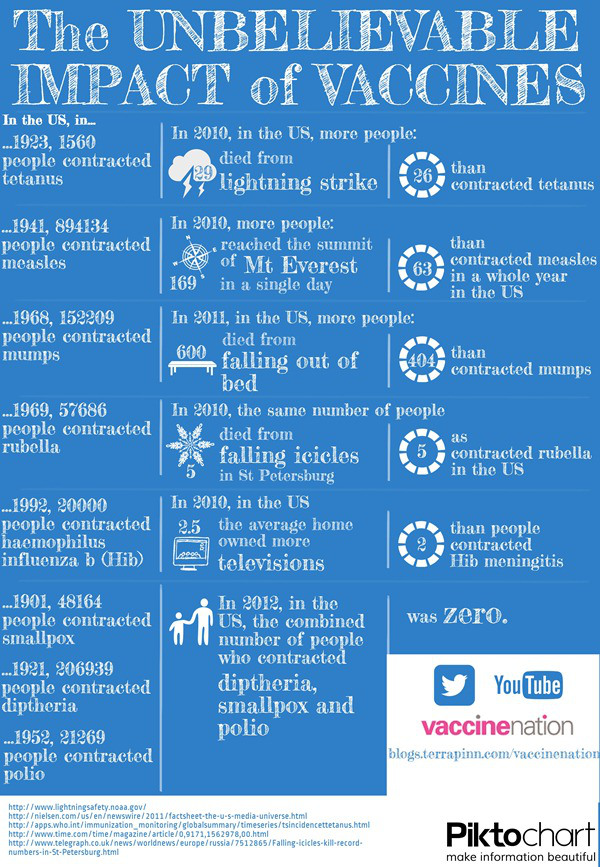
Great Picture posted by my new favourite blog, Science-Based Pharmacy

vaccine-statistics-2-5_thumb

Comments Off on Great Picture posted by my new favourite blog, Science-Based Pharmacy

December 3, 2013 · 4:53 pm

Anti-vaccinationists: Laughing at preventable harms

Forgot to reblog this but it’s in the theme of the bit I just posted…

Comments Off on Anti-vaccinationists: Laughing at preventable harms

Filed under Uncategorized

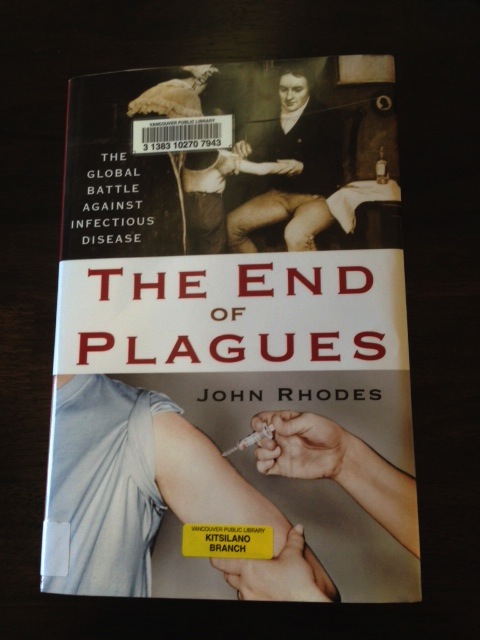
The End of Plagues by John Rhodes

One of my pet peeves is people who don’t vaccinate their kids. Yeah, I said it! Not only is this misguided and misinformed, but actively dangerous to the rest of us. There are people who are immune-compromised, so it’s even more imperative that those of us who can vaccinate do, to protect those very few. If you live in a city, in proximity to other people, it is important to be responsible to your community. If you want to be selfish and irrational, and do exactly what you want when you want to do it, then you should go live in the woods like the Unabomber. It seems that there are definitely people who cherish their notions and will act on them with total disregard for others – until it happens to them. I’ve reblogged a couple of columns by a very good blogger; one is about the dangers inherent in not vaccinating. In one case, a church in Texas promulgated anti-vaccination rhetoric….until their congregation was hit by measles. Then they changed their tune. For some people, that’s always the way. It has to happen to them, then they get it. Tragic.

I think that part of the problem is that there is hardly any living memory of these terrible diseases that we worked so hard to eradicate and immunize against. Anybody remember what a diphtheria epidemic was like? Polio? Smallpox? No. Things of the past, right? Well, they were horrifying enough that people devoted their lives to discovering ways to protect populations from them. Diptheria can kill (these diseases can all kill but diptheria’s mortality rate is 1 in 10 according to the Mayo Clinic website) but if you survive, you’re likely to be crippled, or have heart damage or nerve damage, as in you can’t breathe or swallow. I’d say that’s a pretty serious complication. Ditto polio. Other diseases like measles and scarlet fever can leave you blind and brain-damaged. Still think it’s ok to not vaccinate? Even chicken pox can lead to pneumonia. That’s something that people who think that these diseases aren’t so bad don’t consider. For some reason, the one in a million chance that their child could have an adverse reaction to a vaccine totally outweighs the much higher probability of death resulting from the diseases that these vaccines are meant to prevent. Before vaccinations, these diseases used to sweep through communities, leaving death and disorder in their wake. Winter brought diptheria. Summer brought polio. Look at 10 of the kids at your kid’s school. Picture losing one to diptheria. Picture losing another to whooping cough, and let’s say another two to polio. That’s just out of 10 kids, and that’s just one year. That’s why we developed vaccines, to prevent this kind of tragedy. Still not vivid enough? Here’s a quote about the 1955 polio epidemic in the United States:

“In September, a family living near Milwaukee was devastated by the disease. Four of their eight children were struck down by bulbar polio. In this, the most serious form of polio, the virus invades the cranial nerves that control breathing, swallowing, and speech…The eldest, Paul, was affected first; an athlete of sixteen, he woke up with headache, pain, and weakness in one shoulder. By evening, he could not cough or swallow. In hospital he was placed on a respirator at 6:30 pm; despite all the ministrations of intensive care, he died at 6:50. The next morning his four-year-old sister, Lorraine, woke with a headache and stiff neck and was rushed to hospital. Unlike her big brother, she ate well at suppertime, despite her sore throat, and fell soundly asleep, only to die without waking a few hours later. The day after this, her eight-year-old sister, Mary Ann, complaining of a sore throat and stiff neck, was rushed to hospital. When she began to vomit and had difficulty swallowing, doctors gave oxygen, penicillin, and plasma, and placed her in an iron lung. She continued to answer their questions until 6:15, when she died.

By now the Milwaukee family had lost three of their children, and they were praying hard for the remaining five. But two days later thirteen-year-old Barbara went down with a fever. Her headache was severe, she felt dizzy and nauseous, and in hospital she was fearfully aware of what her symptoms meant. Barbara went through the same intensive treatments as her sisters, but she died at 8 pm.” p. 117

Tragic enough for you? John Rhodes’ nonfiction book, The End of Plagues, is FULL of these stories. It’s a very well-written and concise account of the history of vaccination and immunology. It’s also full of interesting facts which I love, such as that Edward Jenner, who not only came up with the cowpox vaccine, also discovered a plesiosaur fossil. The guy had an interesting life, no? Thomas Jefferson became so passionate about vaccinations that he had his entire family and “staff” immunized, and when the doctor was busy he administered them himself. “By the end of 1801 he had introduced vaccination across Virginia as well as in Philadelphia and Washington, DC…These achievements would be admirable for any scientific investigator, but for a president of the United States they were, and surely must remain, unique.” p. 53

Of course, doctors and scientists such as Jenner and Salk, not to mention health boards, had to deal with people who were frightened of the unknown, and were skeptical of vaccinations. But in those days – Jenner’s first experiment with vaccination was May 14, 1796 – people did sometimes die from complications of the vaccinations. Also, people were not as broadly educated as they are today (you’d think) and of course feared and mistrusted innovation. But people! Hundreds of years have passed. We have education, we have safe vaccines, and even though smallpox has been eradicated, and most of these other diseases are rare in the First World, people still travel and bring back more than postcards with them.

Here’s a good place to insert this fact: VACCINES DON’T CAUSE AUTISM. That crazy theory has been totally disproved. Not to mention: VACCINES DON’T CONTAIN THIOMERSAL (MERCURY DERIVATIVE) AND HAVEN’T SINCE 2003.

Anyway, this book has lots of good information and fascinating history.  I have to finish this off now because it has to go back to the library. I’m going to leave you with a great quote:

“Every friend of humanity must look with pleasure on this discovery, by which one evil more is withdrawn from the condition of man; and must contemplate the possibility, that future improvements and discoveries may still more and more lessen the catalogue of evils. ” Thomas Jefferson, 1800.

And here’s the Mayo Clinic on vaccinations.

Also from scienceblogs.com, an interesting article about the antivaccine movement.

And please do check out this blog, Science-Based Pharmacy. I almost didn’t write this post because he’s got it covered, and he gets credit for finding the scienceblogs post, but I read this book and thought well, why not? There is an excellent chapter on the post World War I flu epidemic that I found interesting as I’m looking at the history of that conflict. (No, I probably won’t blog about that, I’ll spare you.) Overall, it’s a good reminder of what people went through to save us all from the horrific diseases that were the scourge of their time. They succeeded; in fact, they were so successful in controlling and eradicating these diseases that some of us now disregard and actually sometimes vilify the results of their efforts. Isn’t that incredible?
Image

Japan post coming up soon…..

1 Comment

Filed under Uncategorized

Trust, Television Doctors, and 15 Superfoods

This was a subject I was planning to write about, but it’s been done, and more concisely than I probably would have done, right here. Everybody needs to be following this blogger!

Comments Off on Trust, Television Doctors, and 15 Superfoods

Filed under Uncategorized

Use of Homeopathy Kills Child

This is so true, and parents should be aware that reliance on homeopathic and naturopathic products can be dangerous. I think this issue is important enough to reblog, so here it is.

Comments Off on Use of Homeopathy Kills Child

Filed under Uncategorized

Back to Back Borgias: Blood and Beauty: The Borgias by Sarah Dunant, and The Borgias (The Hidden History) by G.J. Meyer

One of my favorite things is to read a historical novel and then follow up with non-fiction  on the same topic. The novel pulls me in, and the nonfiction fills in the gaps. If I were a history teacher, this is how I would engage my students. So here we have a novel on the Borgias by Sarah Dunant, and then a nonfiction treatment of the family by G.J. Meyer, whose book The Tudors I absolutely loved. See blog post here.

Blood and Beauty opens with the election of Rodrigo Borgia to the papacy. Instead of a modest acceptance of the election results, he exults in his new office, sort of like an over-the-top Oscar winner. He immediately begins planning and plotting, insisting his son Cesare become a cardinal even though he will have to do a lot of plotting to pull that off, and building family alliances through his daughter Lucrezia and sons Juan and Jofré. There is lots of political finagling and positioning, interspersed with sessions in bed with his mistress, Giulia Farnese, who is the beautiful blond wife of his nephew! There is much about the political situation of Europe at the time, and the careful balancing of power between France, Spain, and the various principalities that made up 16th-century Italy. Great stuff. If you have the vague notion of the Borgias as this evil, conniving family, with Lucrezia as an incestuous poisoner and Cesare as equally evil (he was the subject of Machiavelli’s The Prince, after all), you will be pleasantly surprised by this more sensitive treatment of a very human family, especially the portrayal of Lucrezia. Interested in learning about the Renaissance? This novel is a good way to start.

(spoiler alert)

Until you read G.J. Meyer’s The Borgias. And realize that all that Borgia hype is just anti-Catholic propaganda! I was very surprised by this. Apparently a few scholars have dug deeper and discovered that 1) Rodrigo Borgia did not father Juan, Cesare, Lucrezia and Jofré, they were his sister’s kids 2) nepotism was normal in those days and if they weren’t his kids it’s not exactly nepotism, 3) they didn’t poison anybody, 4) they didn’t commit incest, 5) Cesare did not kill Juan….and so on. Most importantly, the rise of anti-Catholicism which led to Martin Luther and the Reformation meant that there were writers who had an agenda: blackening the Catholic church in order to justify the Reformation. Why the Borgias, specifically? For one, the pope who succeeded Rodrigo (Pope Alexander VI) was one Giuliano Della Rovere (Pope Julius II) , who was beaten out for the papacy twice, once by a man to whom Borgia was close, then Borgia himself. He hated Rodrigo Borgia. So when he finally got on the hot seat, he was intent on discrediting his predecessor. In fact, he tortured known Borgia associates hoping to extract “damaging material.” Nothing came up but no matter; rumours were good enough and Julius would reward those who provided such fictions. There’s a lot of this in history (i.e. Tudor propaganda vigorously disseminated in order to make Henry VII feel secure, which is why Shakespeare portrayed Richard III as a villainous hunchback; it was the kind of thing that pleased a Tudor monarch), you’d think we’d have learned by now. When writers seeking to advance the cause of the Reformation needed colourful stories to illustrate the corruption of the Catholic church, they easily found all this Julius-promoted scandal and didn’t really question their sources. G.J. Meyer, on the other hand, is very clear about his sources, so I’m inclined to believe this version. He points out that most of the scurrilous stories about the Borgias were written by people who weren’t even alive during the Borgias’ lifetimes. The stories began once the Borgias were dead and the next Pope, a real hater, wanted dirt. When it comes to supposedly-incriminating Vatican documents, he points out that Vatican documents were often forged, and the Borgia-scandal Vatican documents are not even good forgeries. He maps out where Rodrigo Borgia was when the children attributed to him were born, and it’s clear that it was geographically impossible for him to impregnate Vannozza when he was in Spain and she was in Italy. Lots more of that, and it becomes very clear that the Borgias were an interesting Renaissance family, but that’s about it. Although when you look at his achievements, Rodrigo Borgia was a very good Pope! Rather boring, actually! So if you’re enjoying the HBO series The Borgias, just remember to take it with a grain of salt. It’s about as truthful as The Tudors series was.

As a history of the Renaissance, The Borgias is a great book and improves vastly one’s understanding of the political landscape of Italy and Europe. There are many explanatory chapters interspersed with the narrative that deal with the rise of ambassadorships in Europe (started in Italy!), the emergence of global exploration as a powerful mechanism by which a country might rise to prominence (Portugal), and similar Renaissance-related topics which enhance one’s understanding of the narrative.

I’m loving G.J. Meyer’s work and can’t wait to get into another of his books, A World Undone, which is about the First World War.

(please excuse some clunky prose; I’m WAAAAY behind on blog posts and am trying to get it all done before the Christmas rush starts so I’m not editing very carefully)

Comments Off on Back to Back Borgias: Blood and Beauty: The Borgias by Sarah Dunant, and The Borgias (The Hidden History) by G.J. Meyer

Filed under Books

What Matters in Jane Austen? Twenty Crucial Puzzles Solved by John Mullan

If you’re not an Austen fan, this post probably isn’t for you. Fortunately, I am a big Austen fan and I LOVED this book. I wish I’d had it when I was studying the 19th-century novel in university. There are so many significant details to notice in Austen and of course while we noticed some, this book is crammed with many we totally missed.

John Mullan is a professor of English at University College London who also appears on the BBC, and writes a book column for the Guardian, and judges the Booker Prize, so while he is a credited academic he also has a flair for writing for Everyone, which includes me. If you have read at least a few of Austen’s books, you will find this book very entertaining and fun to read. For me, it was revelation after revelation and feeling simultaneously exhilarated by Mullan’s insights and also very foolish for not having noticed these details before, myself. After all, I have read and re-read Austen’s novels for well over 20 years. But I was reading for enjoyment and not necessarily for literary criticism, so that’s my excuse.

What does Mullan investigate? Well, age, for one. He points out that the film adaptations of Austen’s books often miscast actors by age. For instance, Mrs. Bennett is usually portrayed by an actress in her 60s, but as her eldest daughter is only 21, and she was likely married by 18, she is closer to 40. Mr. Collins was played by Tom Hollander, 38, in the most recent adaptation of Pride and Prejudice, but he is introduced by the author as being 25. Similarly, Emma Thompson in Ang Lee’s Sense and Sensibility is 36, but the character, Elinor Dashwood, is 19. And on and on.

The notion of the seaside being a place of instability is actually something we touched on in English class, along with the idea of indoors being somehow more safer and regulated than the outdoors. Brighton is where Lydia Bennett meets up with and elopes with Wickham. In Lyme, Julia Musgrove acts like an idiot and becomes injured. However, Lyme is also the place where Anne Elliot, her complexion revived by the sea air, attracts the admiration of Mr. Elliot (the younger and heir of her father) and also regains the attentions of Captain Wentworth, so there is an element of liberation and freedom along with the danger.

Other issues such as names – what do characters call each other? – are also exposed and examined in great details. How much Money is Enough? and Why is the Weather Important? are chapter titles. I also loved Chapter 16: Are Ill People Really to Blame for Their Illnesses?

Mullan also looks at sex in Jane Austen. Before I read this chapter, I would have said, essentially, that there isn’t any. Well, ok, off the top of my head: Lydia Bennett and Wickham, Maria Rushworth and Henry Crawford and Julia Bertram and John Yates. That’s it, along with the awareness of illegitimacy here and there. However, guided by Mullan’s keen take on Jane Austen and the 19th-century novel, I realized that her books are actually seething with sex or at least the understanding of it, and the impact of sex on the lives of her characters. One of Austen’s themes is that of the marriage made on the basis of sexual attraction which then dissipates, leaving a mismatched and unhappy couple. Mr. Bennett is saddled with the foolish Mrs. Bennett, Mr. Palmer (S & S) with his equally silly wife.  Sir Thomas Bertram and the indolent Lady Bertram and Mr. John Knightley and his wife are more examples. Lucy Steele too, is credited with “considerable beauty” and we must assume that she must be pretty sexy because there is no other reason to marry her, yet she manages to ensnare both Edward Ferrars and his brother Robert. The very famous first sentence of Pride and Prejudice gives away a man’s “need” for a wife. Not because he wants to enter into domesticity per se, but because of a need for a sexual relationship – gasp! I never even considered that before, and I was blown away by this chapter. Armed with a new understanding of Austen code, I now find the novels almost embarrassingly racy: the “great happiness” of Lucy Steele and Robert Ferrars’ honeymoon, the month of sex enjoyed by Lydia Bennett with Wickham before marriage – yikes! Not only that, but Austen indicates which couples enjoy an active sex life via evidence of fertility. Catherine Morland has something like 13 siblings! Yow. Mr. Palmer, though he clearly has contempt for his wife, still also clearly sleeps with her, because she is pregnant in Sense and Sensibility. Mr. and Mrs. Weston, who are married at the beginning of Emma, are pregnant within a month. Hot stuff.

I was also very taken by the chapter on blushing: What Makes Characters Blush? Again Mullan refers to film adaptations: though actors can usually weep on demand, it is impossible to fake a blush, yet blushes are very key to understanding Austen’s characters. Blushing can indicate a social awareness, embarrassment for someone else’s insensitivity. Elizabeth Bennett blushes for her mother’s silly remarks, because her mother lacks the awareness to blush for herself. Elinor Dashwood blushes for the dishonesty of Lucy Steele. Charlotte Lucas blushes when her husband, Mr. Collins, blathers on pompously. Blushing is also connected to innocence, virtue and simplicity. Fanny Price is a champion blusher, always colouring in angry response to others’ indiscreet or disparaging talk, blushing when teased about the unwanted affection of Henry Crawford. Because Fanny is one of Austen’s most silent heroines, her blushes serve as statements of opinion and feeling in lieu of dialogue. She blushes when she’s treated rudely, she blushes when she’s complimented, but she rarely is bold enough to make open remarks. Harriet Smith and Catherine Morland are also blushing left and right, mostly because of their innocence. Blushing also indicates truth and awareness, as Anne Elliot blushes when Mrs. Smith guesses her secret desire for Captain Wentworth. Elizabeth Bennett and Marianne Dashwood also blush with self-consciousness of their secrets, Elizabeth because although she knows that she and Darcy are falling in love, other people are still acting on the assumption that she dislikes him. Marianne blushes because people begin to assume, wrongly, that she and Willoughby are engaged. She knows darn well they aren’t and that they have been behaving in a way that leads to that assumption. Mutual blushing is also given as evidence of mutual love, such as Elizabeth and Darcy’s blushing together. Awwwww.

That’s more detail than I usually give in a book review, and it’s only brief snippets. But it’s pretty interesting, no?

2 Comments

Filed under Books

Summer Books! Spies and Monsters and Teenagers, oh my

There are intelligent books, and there are summer reads. In the summer I’m not looking for challenging literature, because I keep getting interrupted by kids, house guests and meal times. However, this year I’ve had the good fortune to read intelligent books that were also loads of fun, and it’s been wonderful.

Last summer I read Suzanne Collins’ Hunger Games Trilogy. I’d been impressed by this youth lit fantasy so I thought I’d try a few more I’d had recommended to me. Veronica Roth’s Divergent was one such. Once again, dystopian future, disaffected rebellious youth. I liked it enough to download Insurgent, the second book in the series. Book Three is due out some time this fall, so I’ll watch for that.

Cassandra Clare’s ‘City of -‘ books have been made into a movie so I figure they’re really hitting the mainstream and I’d better catch up. I read the first three about a year ago, downloaded the rest, then forgot about it and got her mixed up with Cassandra Clark (more on her work later). I have to keep a list of the books in order so that I don’t get lost. This is important with e-books because you don’t have the benefit of a quick glance at an endplate to see what this one’s all about and where it fits in the series. In this story, there are special descendants of angels called the Nephilim. They are sort of UN peacekeepers of the supernatural world; when vampires, werewolves, or similar get out of line, the Nephilim sort everyone out. Plus they’re gorgeous and really well dressed. The main character finds out late that she is a Nephilim, she falls in love with a Nephilim, there’s a confused bit where they think they’re brother and sister for a while, but then it’s all good, except that her personal style never catches up and she feels really insecure. Her best friend becomes a vampire, her mother’s boyfriend turns out to be a werewolf leader, but they all get along. It’s fun, there’s lots of drama, a certain amount of silliness, but it’s a good read nevertheless. How good? I’ve downloaded her next series, Clockwork this and that. Angel, Prince, Princess, I believe.

I had Cassandra Clark’s books downloaded because initially I mixed her up with Cassandra Clare. I identified my mistake but then looked into the matter and found that Cassandra Clark writes intelligent medieval murder mysteries! Jackpot! I think I actually cheered when I discovered this. Her protagonist is a nun named Hildegard and the stories are set during the reign of Richard II, the boy king, son of the Black Prince, nephew of John of Gaunt. This is a period I’m not very familiar with so I’m happy to have some fun fiction to bring this era to life. Prepare for nerdiness: I find it’s easy to follow the monarchy from William the Conqueror through to Edward I (Longshanks) but then it gets a bit confused (because Sharon Kay Penman’s books stop around there and I have to depend on non-fiction to fill in gaps). Edward II’s wife essentially pulled off a coup with Roger Mortimer and they did away with Edward II, but her son, Edward III (not the offspring of William Wallace, I’m sad to say because that would be awesome) took the throne when he achieved his majority (and executed Mortimer). His son Edward was the Black Prince who died before his father. Richard II was overthrown by his cousin and son of John of Gaunt, Henry Bolingbroke, who became Henry IV. Then Henry V (Agincourt). His son, Henry VI, was a weak king. Because of this and because he had such a strong French wife whom everybody hated (Margaret of Anjou), his cousin Richard of York started going after the throne, thus beginning the Wars of the Roses (Philippa Gregory’s books start here and go right through the Tudors; Sharon Kay Penman has a book about the Wars of the Roses also). That little exposition is not necessary in a quick review of Clark’s books but I just wanted to see if I could do it. One of those bursts of nerdiness that are hard to control. I’m interested in seeing how Clark deals with the downfall of Richard II, so I’m hoping for more Hildegard stories. I’ve read Hangman Blind, The Red Velvet Turnshoe, The Law of Angels, and Parliament of Spies. Enjoyed them all, especially Parliament of Spies and if you read it you’ll know why. Yow! But read them in order first!

In the spring I’d picked up a prominently displayed book by Daniel Silva in the library (thank you library people!) and it was GRIPPING. Whenever a good espionage writer comes along he’s compared to John LeCarré; in my opinion Daniel Silva is even better. I’ve downloaded his Gabriel Allon series (The Kill Artist, The English Assassin, The Confessor, A Death in Vienna, and it goes on) and am galloping through it. Gabriel Allon is an Israeli assassin who daylights as an art restorer. He’s also good-looking, speaks a zillion languages, totally cool. Yet he’s not cheesy. He’s an assassin with a conscience; he was part of the team who avenged the Munich massacre of Israeli athletes. (I’m interested in comparing the characters in the movie Munich to Daniel Silva’s books to see if they correspond.) So far, he’s been part of teams that have blown open Swiss banking collaboration during the war and the major art thefts that happened under the Third Reich and also a team that investigated a threat to a Pope who wants to open the Vatican’s Secret Archives to expose the Church’s role in the Holocaust. Whoa. Interesting and well-researched, and intensely gripping. Just enough description so you can get a good picture in your mind, and enough character development that you have emotional connection to the various players. If you like Ken Follett, John LeCarré and similar you’ll love Silva.

Before we went to the Island I was downloading books for my Sony Reader, and I often visit best-seller lists to see what’s new. Here I found Neil Gaiman’s The Ocean at the End of the Lane and Joe Hill’s NOS4A2. I downloaded them, took them with me on the ferry and started reading. The Neil Gaiman book was hard to read at first because the download had something wrong with it; every apostrophe was misrepresented by a weird tangle of characters. This went on for chapters but eventually the text improved. Nevertheless, I found I was obsessively reading late into the night to see What Happens. It’s one of those charmingly rooted fantasies in which the world of magic is separated from ours by the thinnest of veils. Someone stumbles through, and chaos ensues. It’s lovely and humorous (reminds me a bit of Christopher Moore) and I immediately went back to the Sony site to find other Gaiman books, and found that he is the writer of Stardust, one of our favourite movies.

I read through Joe Hill’s NOS4A2 thinking to myself, “This guy’s read a lot of Stephen King,” because it’s a very Kinglike novel and I honestly think that any writer of horror nowadays has to be familiar with King’s incredible oeuvre, as King himself references H.P. Lovecraft. Vampire writers hearken to Bram Stoker, ghost story writers to Wilkie Collins, etc. So as I read, I thought, Scary, monsters, children, etc. = King influence! Great fun. So then I read the Acknowledgements at the end and he thanks Tabitha King – his mother, which means he’s the son of Stephen King! It’s genetic, folks. Immediate download of previous works followed.

I am a big fan of Barbara Vine – who is actually Ruth Rendell, famous British mystery novelist. I actually prefer the Vine novels however, as they are dark and psychological. The Child’s Child is her newest and once you start reading you are totally sucked in. Rendell is a genius. I’d started to read the new Dan Brown novel and, sorry Dan, it was hard labor. I was doing that thing where you say to yourself, I’ll read 30 pages and then if I’m still not intrigued then I’ll quit. But then I figured, a Canadian summer’s too short for this, and started the Vine book. And she whisked me away into her world. Effortless. I cannot recommend her books highly enough.

Postscript: Before summer began I read two very good nonfiction books which I’ll just name here: Paleofantasy, by Marlene Zuk. There’s a good review in the Guardian on this book. Basically, when someone tells you you need to eat a lot of meat/don’t eat carbs or dairy/run barefoot, because when we were cavemen that’s what we did, they’re full of nonsense. And anyway, cavemen didn’t live so long so why should we copy their habits? They ate meat, or fish, or whatever, because that’s what was available; they didn’t have a Cupcakes store two blocks from their house the way we do. Anyway, archaeologists have proven that they did eat carbs because they analyzed plaque in Neanderthal teeth, so there. Read the book, and you’ll be armed with knowledge against this kind of bizarre notion. I’ve heard a lot of this twaddle lately so I was glad to read a book by an actual evolutionary biologist who is also rolling her eyes. The other is With Charity for All, by Ken Stern. This is about the charity business in the United States and I figure Canada isn’t much different. Good review in the Wall Street Journal online. It was hard to read.I’ve read other books about charities being big frauds but it’s really depressing to seriously contemplate. Nevertheless, it’s well written, well researched and we need to know this stuff!

Comments Off on Summer Books! Spies and Monsters and Teenagers, oh my

Filed under Books